
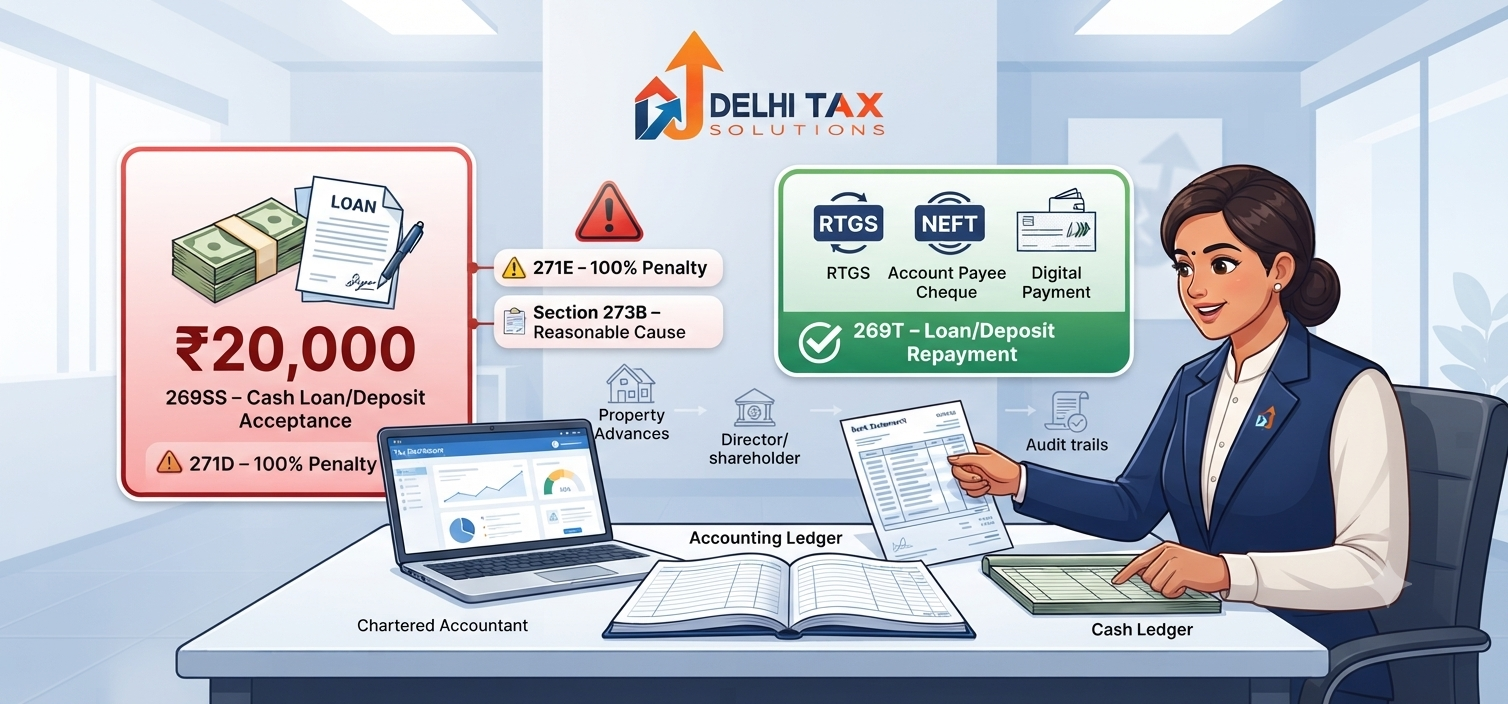
💡 Key Takeaways
- Accepting loans or deposits in cash above ₹20,000 violates Section 269SS.
- Repaying loans or deposits in cash above ₹20,000 breaches Section 269T rules.
- Penalties under Sections 271D and 271E equal 100% of the cash transaction amount.
- Banking channels like account payee cheques or RTGS prevent heavy tax scrutiny.
- Reasonable cause under Section 273B can waive penalties during banking emergencies.
Managing business cash flow requires strict adherence to statutory Indian tax laws where physical currency handovers face heavy regulatory scrutiny. Under the Income Tax Act, accepting or repaying specified loans and deposits in hard cash can trigger aggressive penal consequences. Business founders must understand these boundaries to protect their enterprise capital.
According to compliance frameworks outlined by the Income Tax Department, bypassing banking channels for high-value transactions is treated as an anti-tax-evasion measure. As per cases handled by our CA team at Delhi Tax Solutions, taxpayers frequently invite 100% cash transaction limits section 269ss 269t penalties simply due to a lack of awareness regarding inter-family loans and urgent business advances. Let us explore how to navigate these rules securely.
Understanding Cash Transaction Limits Under Section 269SS and 269T
Section 269SS and Section 271D form the legislative bedrock designed to curb unaccounted money circulation in India. Section 269SS explicitly prohibits any person from accepting a loan, deposit, or specified advance for immovable property in cash if the aggregate amount equals or exceeds ₹20,000. This threshold applies strictly per transaction, per person, and per financial year.
Conversely, Section 269T governs the repayment side, dictating that loans or deposits—including any interest accrued thereon—cannot be repaid in cash if the aggregate sum is ₹20,000 or more. Businesses expanding operations through proper company registration must establish strict treasury protocols to ensure all proprietor or director cash infusions route through official banking networks. Furthermore, maintaining rigorous ledger records prevents accidental breaches during urgent capital adjustments. Founders managing business liquidity alongside start business advisory frameworks must audit their cash registries monthly.
Legislative Objectives
Designed specifically to track unaccounted currency circulation and minimize black money routing in domestic commerce.
The ₹20,000 Aggregate Threshold
Applies strictly per transaction, per person, and cumulatively across the financial calendar.
Property Advance Coverage
Extends comprehensively to earnest money and advance payments received against the transfer of immovable assets.
Decoding Section 269SS for Cash Loan Acceptances
Section 269SS targets the inflow of cash into business and personal accounts. If a taxpayer accepts a loan or deposit of ₹20,000 or more via physical cash, bearer cheque, or cash hundi, the transaction is illegal under income tax provisions. This restriction extends to advances received for the transfer of immovable property even if the final sale deed is pending.
When assessing section 269ss penalty cash loan violations, tax officers do not examine whether the cash was eventually accounted for in the balance sheet. The mere act of accepting physical cash above the statutory limit attracts a penalty under Section 271D equal to 100% of the sum so accepted. Such rigorous enforcement leaves zero margin for casual bookkeeping errors. To streamline treasury workflows, enterprises must enforce digital-only policies for director loans. Integrating proper business licenses and corporate accounting software ensures all capital introductions are captured via Account Payee Cheques, Demand Drafts, or Electronic Clearing Systems (ECS).
Inflow Restrictions
Governs unsecured borrowings, director advances, and short-term capital handovers from external contributors.
Irrelevance of Balance Sheet Intent
Proper accounting entry integration does not absolve a taxpayer from penalties if physical cash was accepted.
Section 271D Trigger
Initiates a mandatory 100% financial penalty equivalent to the precise cash amount accepted.
Navigating Section 269T for Loan and Deposit Repayments
Section 269T regulates the outflow of funds when returning loans, deposits, or specified advances. If a corporate entity or individual repays a loan exceeding ₹20,000 in cash, they violate statutory mandates. This applies equally to cooperative banks, financial institutions, and private limited companies.
The penalty for violating repayment rules is enforced under Section 271E, which levies a fine equal to 100% of the cash amount repaid. According to economic data tracked by the Press Information Bureau, automated scrutiny tools deployed by tax authorities cross-reference bank statements with annual information returns to flag illegal cash repayments instantly. Corporate entities engaging in high-volume vendor settlements must maintain rigorous documentation. Utilizing professional oversight ensures that all debt liquidations comply fully with Reserve Bank of India and direct tax regulations.
Outflow Regulations
Applies to the systematic return of principal amounts alongside any accumulated interest liabilities.
Entity-Wide Applicability
Binds corporate firms, banking entities, partnerships, and sole proprietorships uniformly.
Automated Data Matching
Advanced tax intelligence systems flag banking mismatches and physical cash withdrawals instantaneously.
Penalties Under Section 271D and 271E
Penalties under Section 271D (for accepting cash loans) and Section 271E (for repaying cash loans) are severe. The penalty amount is precisely 100% of the loan or deposit accepted or repaid in cash. For instance, accepting a cash loan of ₹5,00,000 from a relative invokes a penalty of ₹5,00,000 under Section 271D, independent of regular income tax assessments.
However, Section 273B provides a crucial safety valve. If the taxpayer proves that there was a reasonable cause for the cash transaction—such as a complete bank strike, medical emergency in a remote area where banking was unavailable, or bona fide belief—the Joint Commissioner may waive the penalty. To avoid these heavy financial drains, maintaining disciplined digital audit trails is crucial. Businesses should keep their GST registration and direct tax compliance synced to withstand multi-departmental audits without friction.
100% Quantum Penalty
Monetary fines match the exact value of the illegal cash transaction regardless of tax bracket or income levels.
The Section 273B Safety Valve
Provides legal relief where compelling, unavoidable circumstances prevented the use of digital banking mechanisms.
Multi-Departmental Audits
Integrating tax systems ensures compliance data correlates smoothly across GST and direct tax registries.
Step-by-Step Compliance Protocol to Avoid Penalties
Safeguarding your enterprise from cash penalty notices requires a methodical, automated approach to daily accounting and treasury management. Executing each step systematically eliminates exposure to tax default notices.
- Enforce Digital-Only Capital Inflow: Mandate that all director loans, shareholder advances, and unsecured borrowings enter the company bank via RTGS, NEFT, or account payee cheques.
- Screen Property Advances: Ensure any earnest money or advance for immovable property exceeding ₹20,000 is received strictly through banking channels.
- Audit Repayment Channels: Verify that principal and interest repayments on loans are transferred directly to the lender’s verified bank account.
- Maintain Contemporaneous Documentation: Keep bank statements, loan agreements, and confirmation letters handy to substantiate commercial expediency.
- Consult Certified Tax Experts: Partner with professional advisors to review cash registers before filing annual tax returns and audit reports.
Proper adherence to these operational safeguards protects your enterprise from automated default notices and secures your corporate credit rating.
Digital Inflow Mandates
Routing all equity and debt injections through automated electronic clearance channels.
Regular Treasury Audits
Conducting monthly internal checks on cash flow journals to identify potential statutory breaches early.
Documentation Protocols
Preserving robust contractual agreements to validate the commercial legitimacy of every corporate loan.
Frequently Asked Questions (FAQs)
Q: What is the penalty under Section 269SS for taking a cash loan?
A: Under Section 271D of the Income Tax Act, accepting any loan, deposit, or specified advance in cash of ₹20,000 or more attracts a penalty equal to 100% of the amount so accepted. This means if a business accepts ₹50,000 in physical cash from an individual, the penal fine imposed by the tax officer will be exactly ₹50,000, irrespective of the legitimacy of the underlying business transaction.
Q: Can I repay a deposit or loan in cash if the amount is above ₹20,000?
A: No. Section 269T strictly prohibits repaying any loan or deposit—including accumulated interest—in cash if the aggregate repayment equals or exceeds ₹20,000. Any default in this regard invites a 100% penalty under Section 271E. All repayments must be routed through account payee cheques, bank drafts, or electronic clearing systems linked to verified bank accounts.
Q: How does the Income Tax Department detect cash transactions violating 269SS and 269T?
A: The Income Tax Department utilizes advanced data analytics engines that cross-verify Tax Audit Reports (Form 3CD), Annual Information Statements (AIS), and bank statements submitted by corporate entities. When chartered accountants report cash loans or repayments exceeding ₹20,000 in tax audits, automated notices are triggered instantly under Section 271D and 271E.
Q: Are transactions between family members exempt from Section 269SS limits?
A: No. Section 269SS and 269T make no exceptions for family members, relatives, or associated group companies. Taking an emergency cash loan of ₹25,000 from a parent or spouse is subject to the exact same statutory restriction and 100% penalty risk as a loan taken from an unrelated third party, unless genuine reasonable cause under Section 273B is established.
Q: What is the difference between penalties under Section 271D and Section 271E?
A: Section 271D penalizes the acceptance of loans, deposits, or property advances in cash exceeding ₹20,000 in violation of Section 269SS. In contrast, Section 271E penalizes the repayment of loans or deposits in cash exceeding ₹20,000 in violation of Section 269T. Both penalties carry a 100% fine of the transaction value and are levied by the Joint Commissioner of Income Tax.
About this article: Researched using official government sources and Delhi Tax Solutions’ in-house tax advisory team. Last updated September 2026. This article is for general informational purposes and is not a substitute for personalised professional tax advice.
