
💡 Key Takeaways
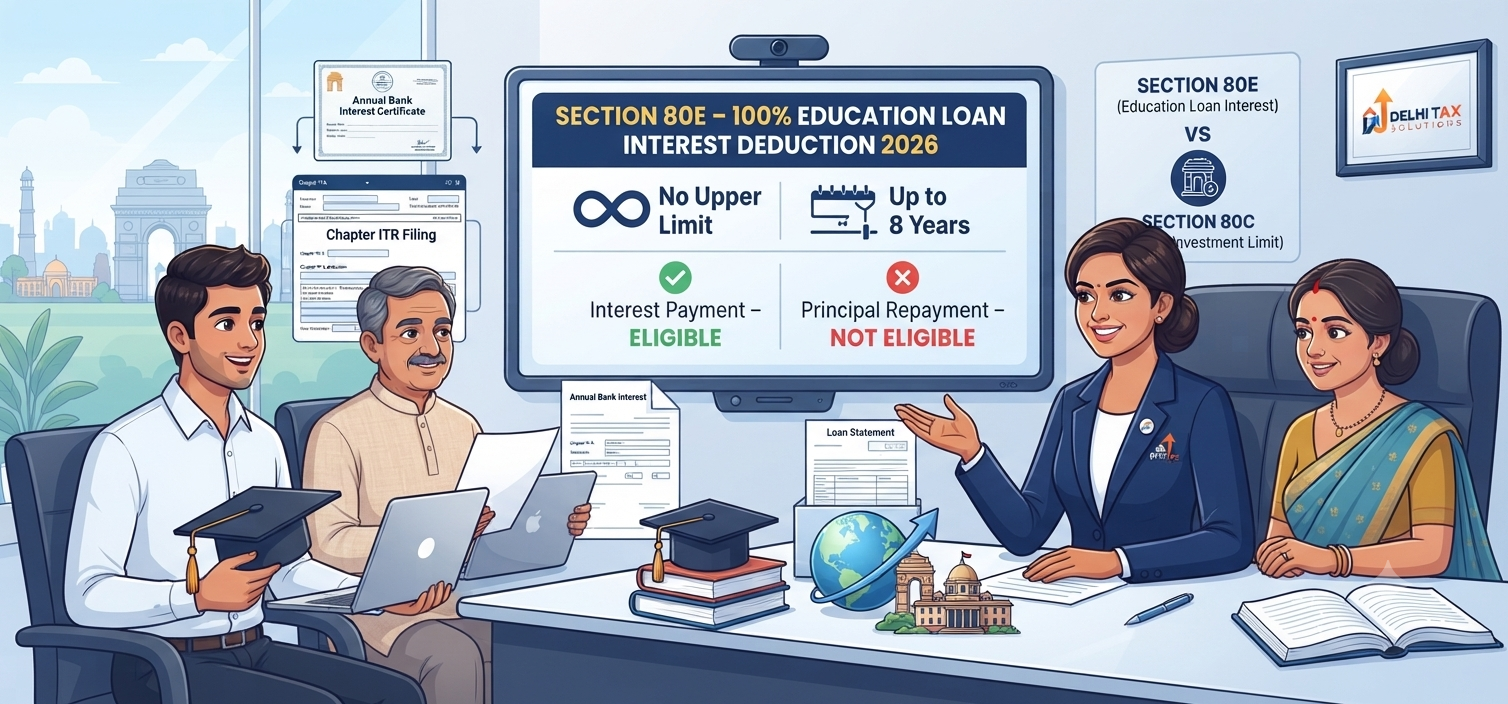
- Section 80E allows 100% tax deduction on education loan interest for higher studies.
- No upper monetary limit is imposed on the interest amount you can claim.
- The deduction is available for a maximum of 8 consecutive financial years.
- Only individual taxpayers taking loans for self, spouse, or children can claim it.
- Loans must be taken from approved charitable or financial institutions.
Financing higher education in India or abroad is a major financial milestone for ambitious students and supportive parents alike. With tuition fees and living expenses scaling higher each academic year, education loans have become an essential stepping stone. Fortunately, the Income Tax Department of India provides substantial relief through Section 80E, allowing taxpayers to significantly lower their taxable income by claiming deductions on the interest paid towards these loans. Understanding the nuanced eligibility criteria, documentation, and the step-by-step claim process ensures you do not leave valuable tax savings on the table during your annual ITR filing.
What is Section 80E and Who Qualifies for the Tax Benefit?
Section 80E of the Income Tax Act, 1961, provides a dedicated deduction exclusively for individuals who have taken an education loan for pursuing higher education. As per guidelines established by the Income Tax Department, this deduction covers interest paid during the financial year on loans secured for full-time graduate or postgraduate studies in professional, technical, or pure academic disciplines. Crucially, the loan must be taken for oneself, a spouse, or children, or for a student for whom the taxpayer acts as a legal guardian. This targeted provision ensures that families investing in advanced career development receive tangible financial support from the government.
To qualify seamlessly under this provision, the loan must originate from recognized financial institutions, public sector banks, or approved charitable institutions. Loans borrowed informally from family members, friends, or unverified private lenders do not qualify for Section 80E deductions. When preparing your documentation for the financial year 2025-26 or assessment year 2026-27, obtaining an official interest certificate from your lending institution is paramount. For comprehensive assistance on managing your overall tax liabilities, you can explore professional Income Tax Services tailored for salaried professionals and business owners.
Statutory Scope and Institutional Mandates
Qualifying for this deduction requires strict alignment with recognized institutional frameworks. Only loans issued by scheduled commercial banks, notified financial institutions, and approved charitable organizations are honored by tax authorities.
Beneficiary Limitations
The law explicitly restricts eligible relationships to self, spouse, and children. Loans taken for siblings, parents, or extended relatives do not qualify under Section 80E, making proper borrower structuring essential before loan sanctioning.
Academic Disciplines Covered
Both technical professional courses and traditional academic degree programs qualify, provided they are full-time courses pursued after completing senior secondary education.
Understanding Education Loan Interest Deduction ITR Rules and Limits
Navigating the exact parameters of education loan interest deduction ITR filing requirements requires attention to quantitative thresholds and time caps. Unlike Section 80C, which imposes a strict aggregate ceiling of ₹1.5 lakh across various instruments, Section 80E places no upper limit on the quantum of interest you can claim. If your annual interest outgo stands at ₹2 Lakhs, ₹3 Lakhs, or even higher, the entire interest component is fully deductible from your gross total income.
However, this provision comes with a strict chronological limitation: the 8-year rule. The deduction is available for a maximum of 8 consecutive financial years, beginning from the year in which you start repaying the interest, or until the interest is paid in full—whichever happens earlier. Once this 8-year window elapses, any remaining interest cannot be claimed, even if the principal loan balance persists. Strategic financial planning, including partial prepayments during peak earning years, can maximize the utility of this window. For business owners and entrepreneurs scaling their ventures, aligning personal tax deductions with corporate structures like Company Registration helps optimize overall family wealth management.
⚡ In a Nutshell: Maximizing Section 80E
- Section 80E provides an uncapped deduction on education loan interest for higher studies.
- Available for up to 8 consecutive financial years from repayment commencement.
- Applies strictly to loans taken for self, spouse, or children from recognized institutions.
The 8-Year Clock Mechanics
The limitation period begins counting from the exact financial year interest repayment starts, regardless of whether you claim the deduction in those early years. Pausing or skipping a year does not extend the overall 8-year statutory window.
No Monetary Ceiling Advantages
Because higher education abroad frequently incurs massive interest liabilities, the absence of a monetary cap provides immense financial relief to high-income earners and middle-class families alike.
Tax Regime Restrictions
Taxpayers must note that deductions under Chapter VI-A, including Section 80E, are exclusively available under the old tax regime and cannot be claimed if you opt for the concessional new tax regime.
Section 80E Eligibility Criteria India: Qualifying Courses and Institutions
Establishing correct Section 80E eligibility criteria India compliance is vital to prevent scrutiny or disallowance by tax authorities. The statute specifies that the loan must be utilized for ‘higher education’, which legally encompasses any full-time course undertaken after passing the Senior Secondary Examination (Class 12) or its equivalent from a recognized school, board, or university. Both regular vocational programs and traditional degree programs qualify without ambiguity.
Both domestic and international universities are covered under the purview of Section 80E, making it exceptionally beneficial for students pursuing master’s degrees overseas. Furthermore, both scientific and management courses, along with technical diplomas, are fully eligible. It is important to note that part-time courses, distance learning programs, or casual coaching classes generally do not meet the strict statutory definition of higher education required under this section. Before finalizing your loan agreements, verifying institutional accreditation through bodies recognized by the Ministry of Corporate Affairs or university grants commissions ensures smooth processing. For new business ventures started by fresh graduates, checking Start Business guidelines can provide valuable compliance roadmaps.
Full-Time vs. Distance Learning
Tax authorities strictly interpret ‘higher education’ to exclude part-time or distance learning courses, ensuring that only dedicated, full-time academic or professional pursuits qualify for this tax shield.
Overseas Education Coverage
Foreign university enrollments are fully covered, provided the institution is recognized by the appropriate regulatory authorities in that foreign country and the loan is sourced through authorized banking channels.
Vocational and Professional Certifications
Recognized professional diplomas and post-graduate vocational training programs qualify seamlessly, bridging the gap between standard university degrees and technical skill development.
Maximum Limit for Section 80E Deduction and Principal Exclusion
A frequent point of confusion among taxpayers revolves around the maximum limit for Section 80E deduction and the treatment of the principal repayment amount. While the interest paid on the education loan enjoys 100% tax deduction with zero upper ceiling, the principal repayment component is strictly ineligible for any tax deduction under Section 80E. Taxpayers often mistakenly assume both components qualify, leading to calculation discrepancies during electronic filing.
To clarify this structural difference clearly, consider the following statutory comparison between Section 80E and Section 80C:
| Feature / Parameter | Section 80E (Education Loan) | Section 80C (General Savings) |
|---|---|---|
| Eligible Component | Only Interest Payment | Principal Repayment (Tuition fees also covered) |
| Maximum Deduction Limit | No Upper Limit (100% of interest) | Capped at ₹1.5 Lakhs per annum |
| Time Duration Cap | Maximum 8 consecutive financial years | Ongoing as long as investments/payments continue |
| Eligible Beneficiaries | Self, Spouse, Children, or Legal Ward | Self, Children (Tuition fee component) |
Understanding these boundaries prevents erroneous claims that trigger automated scrutiny notices from the tax department. For entrepreneurs managing indirect taxation alongside personal compliance, ensuring proper GST Registration and filing is equally essential for comprehensive business health.
Separating Principal and Interest
Lenders provide annual breakup certificates. Always use the explicit interest figure and leave out principal outflows when populating your ITR deduction schedules.
Interaction with Section 80C
While Section 80E handles education loan interest, tuition fees paid out of pocket for children’s education can simultaneously be claimed under Section 80C up to the aggregate ₹1.5 lakh limit.
Avoiding Common Filing Errors
Mixing up principal and interest components is one of the most common triggers for automated rectification notices from the Central Processing Centre (CPC).
How to Claim Education Loan Tax Benefit in Your Annual Return
Executing how to claim education loan tax benefit correctly during your ITR filing process involves systematic documentation and accurate reporting on the income tax portal. When filing forms ITR-2 or ITR-3, navigate to the Chapter VI-A deduction schedules and input the precise interest figure under the Section 80E field. You do not need to upload physical receipts or bank statements during submission, but you must retain these records safely for at least six years in case the tax authorities request verification.
Before initiating your filing, request a formal Interest Statement from your bank or financial institution, which clearly segregates the principal repayment from the interest amount paid during the financial year. Ensuring this segregation is accurate prevents calculation errors. For comprehensive business entities and MSMEs supporting employee education policies, maintaining proper Business Licenses and regulatory documentation is fundamental. Additionally, keeping track of TDS Filing requirements ensures seamless corporate compliance across all operational verticals.
Document Retention Protocols
Keep your loan sanction letters, amortization schedules, and annual bank interest certificates archived digitally for a minimum of six years to comply with statutory record-keeping rules.
ITR Form Selection
Salaried individuals with capital gains or multiple house properties typically file ITR-2, whereas business owners file ITR-3, both of which feature dedicated fields for Chapter VI-A deductions.
Employer Declaration via Form 12BB
Submit your projected interest outgo and lender details via Form 12BB to your employer’s payroll desk before the fiscal year ends to prevent excessive tax deduction at source (TDS).
Higher Education Loan Tax Exemption AY 2026-27: Key Compliance Steps
As we approach the compliance cycles for higher education loan tax exemption AY 2026-27, taxpayers must remain vigilant about procedural timelines and documentation standards. The transition to modern tax portals has streamlined verification, making prompt and accurate data entry more critical than ever. According to advisories from the Udyam Registration and MSME support frameworks, financial discipline among small business owners directly correlates with robust personal tax management. When claiming your Section 80E deduction, always ensure that the loan account is active and that payments were made out of taxed income sources during the relevant financial year.
Our expert tax advisory team at Delhi Tax Solutions frequently encounters taxpayers who miss out on deductions due to minor reporting mismatches or delayed certificate generation. Consulting a qualified Chartered Accountant before submitting your ITR ensures absolute accuracy, optimizes your tax slab benefits, and safeguards your filings against unnecessary scrutiny. Whether you are navigating complex corporate structuring via Direct Tax Code advisory or personal deductions, professional guidance delivers peace of mind.
Timely Portal Verification
Ensure your Annual Information Statement (AIS) and Form 26AS align perfectly with the interest figures reported by your lending institution to prevent automated mismatch flags.
Active Loan Status Verification
Verify that your loan account remains in regular repayment standing and that no default notices or restructuring changes alter your tax interest accounting.
Professional Consultation Value
Engaging professional tax advisors ensures that overlapping deductions, regime switches, and high-value loan structures are optimized safely without risking compliance penalties.
Frequently Asked Questions (FAQs)
Q: Is principal amount of education loan tax deductible under Section 80E?
A: No, the principal repayment component of an education loan is strictly ineligible for any tax deduction under Section 80E. The statutory provisions of this section apply exclusively to the interest component paid during the financial year. Taxpayers often confuse this with Section 80C, where principal repayments and tuition fees for certain children’s education qualify up to ₹1.5 Lakhs. Therefore, when filing your annual Income Tax Return, you must carefully segregate the principal and interest amounts using the official interest certificate provided by your lending bank.
Q: How many years can I claim Section 80E deduction?
A: You can claim the Section 80E tax deduction for a maximum of 8 consecutive financial years. This 8-year clock begins strictly from the financial year in which you start paying the interest on your higher education loan, or until the interest is paid off in full by the borrower, whichever condition occurs earlier. Once this 8-year timeframe lapses, any remaining interest outstanding cannot be claimed as a deduction under Section 80E, even if a portion of the principal loan balance continues to remain unpaid.
Q: Can I claim Section 80E for education loan taken from friends or relatives?
A: No, you cannot claim tax deductions under Section 80E if your education loan has been borrowed informally from friends, relatives, employers, or unverified private moneylenders. The Income Tax Act explicitly mandates that qualifying loans must be secured exclusively from recognized financial institutions, scheduled banks, or approved charitable institutions registered under Indian banking and financial regulations. Always ensure your loan agreement is executed with a formal banking institution to secure valid interest certificates for ITR filing.
Q: Can parents claim Section 80E deduction for a loan taken for their children?
A: Yes, parents can legally claim the Section 80E tax deduction if they have taken an education loan for the higher education of their children. The statute explicitly covers loans taken for the taxpayer themselves, their spouse, their children, or a student for whom the taxpayer acts as a legal guardian. It does not matter whether the student is studying domestically in India or abroad at an international university, provided the course qualifies as a recognized full-time higher education program.
Q: Is there any upper monetary limit on the interest amount claimed under Section 80E?
A: No, there is absolutely no upper monetary cap or ceiling on the amount of interest you can claim as a deduction under Section 80E. Unlike many other tax-saving provisions in Chapter VI-A that restrict deductions to specific monetary limits (such as ₹1.5 Lakhs under Section 80C), Section 80E allows 100% of the actual interest paid during the financial year to be deducted from your taxable income, making it exceptionally beneficial for expensive professional and international courses.
About this article: Researched using official government sources and Delhi Tax Solutions’ in-house tax advisory team. Last updated September 2026. This article is for general informational purposes and is not a substitute for personalised professional tax advice.
