
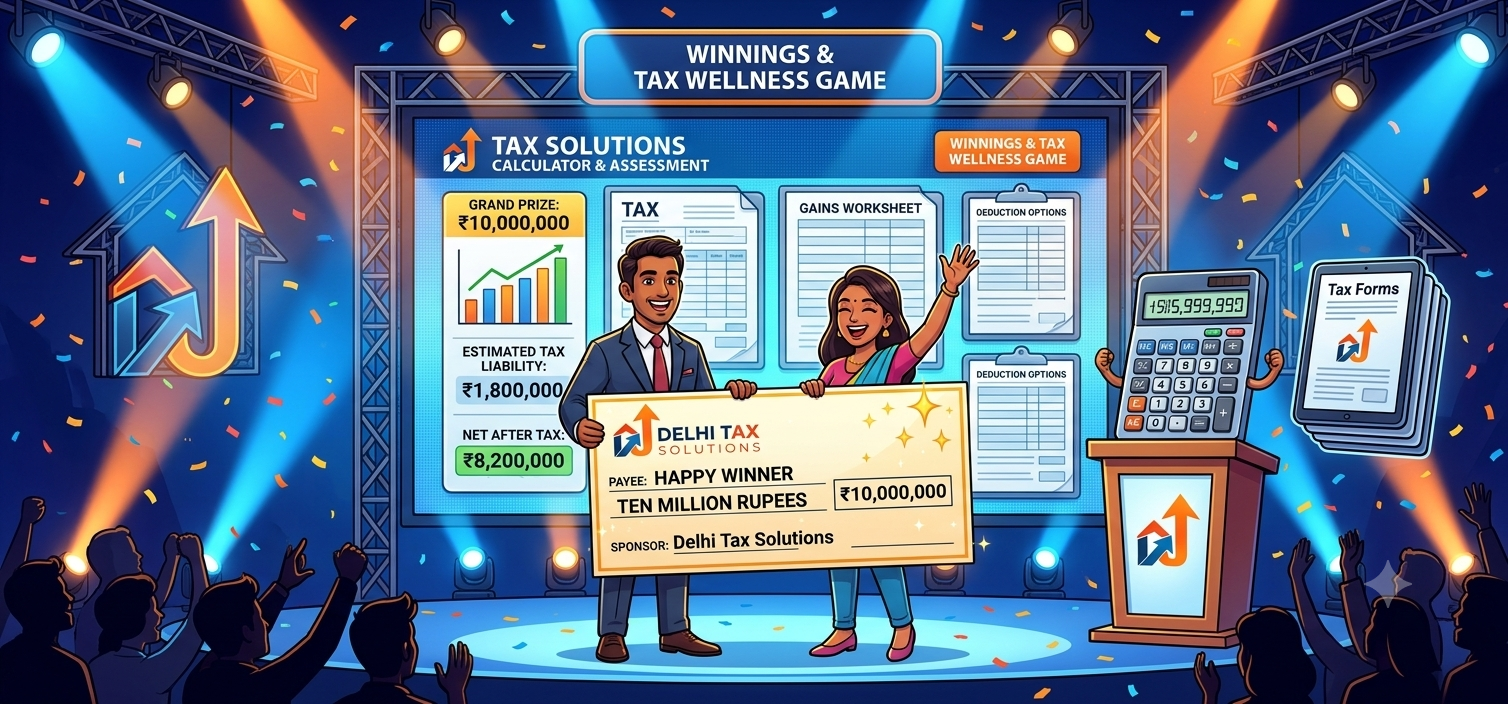
💡 Key Takeaways
- Game show winnings face a flat 30% statutory income tax without exception.
- TDS applies automatically at the source if the prize money exceeds ₹10,000.
- You cannot claim any standard deductions or basic exemption limits against this income.
- The effective tax rate reaches 31.2% after adding the mandatory 4% health and education cess.
- Winners must report this specific income under the “Income from Other Sources” schedule in their ITR.
Winning ₹1 Crore on national television sounds instantly life-changing until the taxman claims his statutory share before you even leave the studio. For decades, audiences watching high-stakes reality broadcasts have wondered exactly how much cash the victor truly takes home. Based on cases handled by our CA team, the statutory reality of prize money is exceptionally strict, leaving no room for financial maneuvering or standard deductions.
According to the official frameworks published by the Income Tax Department, sudden wealth generated from entertainment platforms triggers immediate, heavy taxation. The tax on game show winnings India is designed to capture revenue at the highest possible bracket instantly. This comprehensive guide breaks down the precise mathematical realities, TDS mandates, and mandatory compliance steps required when you win big.
What is the Tax on Game Show Winnings in India?
The tax on game show winnings India is a mandatory, flat 30% income tax applied to any prize money originating from television shows, lotteries, crossword puzzles, or reality entertainment. Authorized under Section 115BB income tax act provisions, this specific tax is absolute and unavoidable. It applies universally to all participants, regardless of their standard annual income, professional status, or existing tax bracket. Once you add the mandatory 4% health and education cess on the calculated tax amount, the effective tax rate automatically increases to a stringent 31.2%.
Television production companies enforce these deductions strictly to maintain their corporate compliance standings. Broadcasters designing these prize structures often consult compliance experts through portals like our Tax & Compliance Blog Index to ensure their payout mechanisms align with national laws.
Understanding the Tax on KBC Winnings
Analyzing the tax on KBC winnings provides the perfect real-world example of how these statutory rules function in practice. If a contestant wins the legendary ₹1 Crore prize, they do not receive ₹1 Crore in their bank account. The broadcaster immediately isolates the taxable amount before initiating any financial transfer. The production company calculates 30% of the gross winnings, adds the applicable cess, and deducts it directly at the source.
Consequently, a ₹1 Crore winner actually takes home approximately ₹68,80,000 after the 31.2% deduction. The television network legally deposits the remaining ₹31,20,000 directly to the government on the winner’s behalf. If you are launching a promotional game for your startup that involves prize payouts, you must legally structure these TDS mechanisms first; our CA team can guide you through our Start Your Business Hub.
How the TDS on Game Show Winnings Section Works
The specific mandate enforcing this upfront deduction is the TDS on game show winnings section, officially known as Section 194B TDS. This law dictates that any entity distributing prize money exceeding ₹10,000 must deduct tax at source before paying the winner. If the prize is a physical asset—like a luxury car or a gold bar—the winner must pay the equivalent tax amount out of pocket before the broadcaster will legally release the asset to them.
This stringent threshold ensures that even minor reality TV tax liabilities are captured immediately. Official bulletins from the Press Information Bureau frequently reiterate the government’s zero-tolerance policy toward undeclared prize money. If you receive a smaller prize where TDS was incorrectly missed, you must manually declare and pay it; we simplify this through our TDS Returns & Advisory services.
Standard Income vs the 30% Flat Tax Lottery Game Show
Taxpayers routinely confuse standard salary taxation with the rules governing a 30% flat tax lottery game show. When you earn a standard salary, you benefit from progressive slab rates and numerous deductions. When you earn prize money tax, the government categorizes it as Income from Other Sources, and strips away all standard financial protections. The comparison table below highlights these drastic statutory differences.
| Tax Parameter | Standard Salary / Business Income | Game Show & Lottery Winnings |
|---|---|---|
| Base Tax Rate | Progressive (0% to 30% based on slab) | Flat 30% regardless of total income |
| Basic Exemption Limit | Allowed (e.g., ₹3,00,000 limit) | Not Allowed (Taxed from the first Rupee) |
| Chapter VI-A Deductions | Allowed (80C, 80D, etc.) | Strictly Not Allowed |
| TDS Threshold | Varies heavily by income type | Strictly applied above ₹10,000 |
For cross-border participants, the Reserve Bank of India heavily regulates the repatriation of Indian prize money to foreign accounts. Non-resident Indians participating in domestic shows must navigate these strict financial corridors. Entrepreneurs looking to establish formal businesses using their newly acquired capital can secure their legal foundation via GST Registration Online.
⚡ Quick Summary
Under Indian tax law, you cannot use your game show winnings to claim standard 80C deductions. Even if your total annual income is strictly zero, winning ₹50,000 on a TV show means you will instantly lose 31.2% of it to the government.
Filing ITR for Prize Money and Ensuring Compliance
Even though the television network deducts the tax automatically, your legal obligations are not complete. ITR filing for prize money is a mandatory statutory requirement. Taxpayers must declare the gross winning amount under the specific schedule for Income from Other Sources. The tax already deducted by the broadcaster will reflect in your Form 26AS as a TDS credit, proving to the government that the liability is settled.
Failing to explicitly declare this lottery tax India revenue in your annual return triggers automated scrutiny notices from the Central Board of Direct Taxes (CBDT). According to our CA team, hiding prize money is impossible due to strict PAN-linked corporate reporting. Ensure your returns are flawless by engaging our dedicated Income Tax Services & ITR Filing professionals before the July deadline.
About this article: Researched using official government sources and Delhi Tax Solutions’ in-house tax advisory team. Last updated August 2026.
Frequently Asked Questions (FAQs)
Q: What is the exact tax on game show winnings India?
A: The exact tax on game show winnings India is a mandatory, flat 30% income tax applied to the gross prize amount. Once you add the mandatory 4% health and education cess on the calculated tax, the effective tax rate reaches 31.2%. This stringent rate applies universally to all reality TV and game show payouts under Section 115BB of the Income Tax Act.
Q: How is the tax on KBC winnings calculated if I win ₹1 Crore?
A: If you win ₹1 Crore on KBC, the broadcaster immediately deducts the 31.2% effective tax at the source before paying you. They calculate 30% of ₹1 Crore (₹30,00,000) and add the 4% cess on that tax amount (₹1,20,000). The total deduction is ₹31,20,000. Therefore, you receive a net bank transfer of exactly ₹68,80,000.
Q: What is the TDS on game show winnings section and threshold?
A: The TDS on game show winnings section is Section 194B of the Income Tax Act. Under this specific statutory provision, any entity paying out prize money that exceeds the threshold of ₹10,000 is legally required to deduct tax at source at the 30% rate before transferring the balance to the winning participant.
Q: Can I claim basic exemption limits against a 30% flat tax lottery game show?
A: No, you absolutely cannot claim basic exemption limits against a 30% flat tax lottery game show payout. The Income Tax Act explicitly prohibits setting off game show winnings against the basic exemption limit (such as the ₹3,00,000 threshold). You also cannot claim any Chapter VI-A deductions, such as Section 80C or 80D investments, against this specific prize money.
Q: How do I report reality TV tax liabilities in my annual ITR?
A: You must report reality TV tax liabilities by declaring the total, gross prize amount in your Income Tax Return under the “Income from Other Sources” schedule. You must file ITR-2 or ITR-3, as ITR-1 cannot be used for this specific income type. The TDS deducted by the broadcaster will automatically reflect in your Form 26AS, confirming your compliance.
