
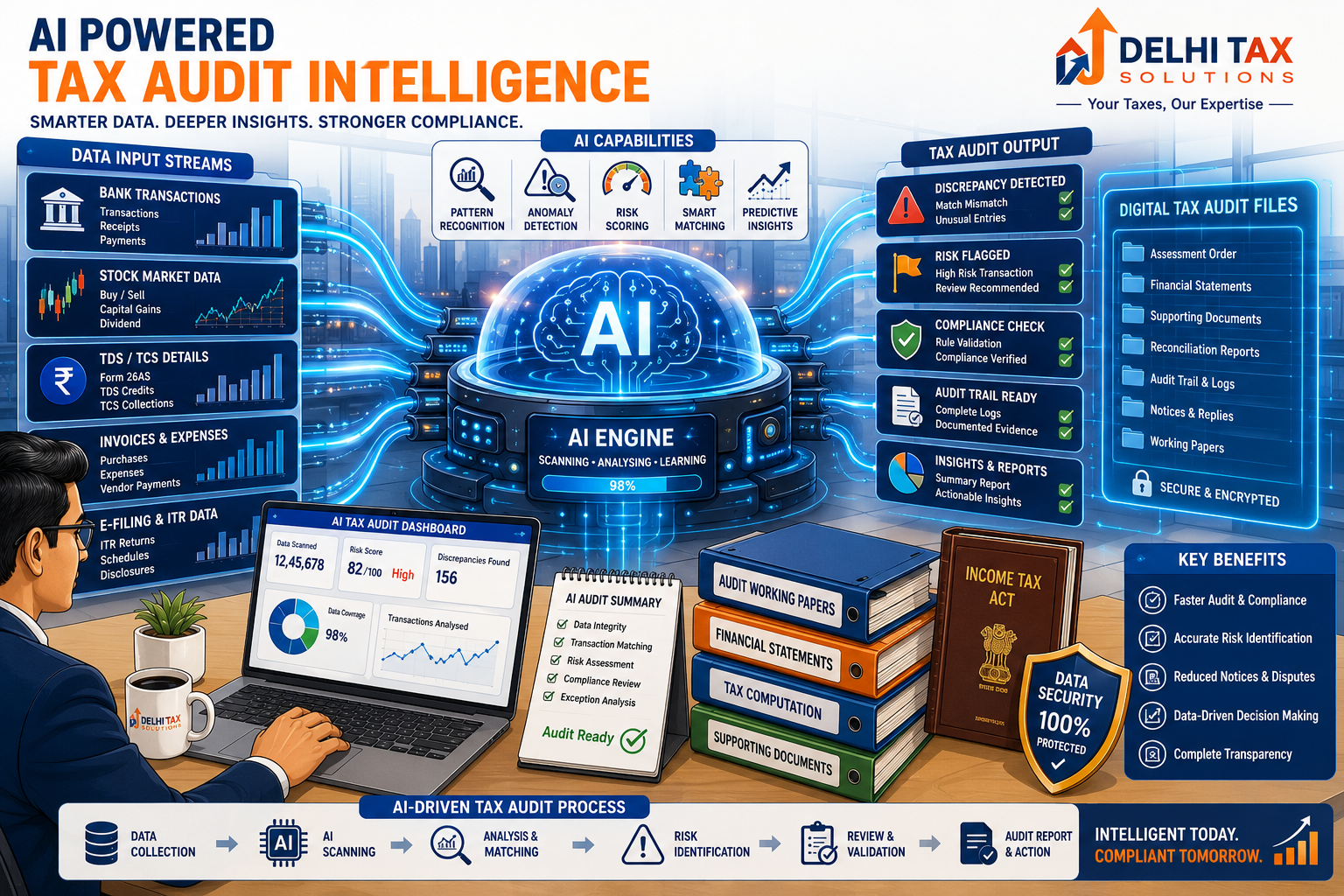
💡 Key Takeaways
- AI models scan millions of financial transactions to spot hidden tax evasion.
- AIS matching flags discrepancies between bank interest, stock trades, and filed ITRs.
- Project Insight integrates big data analytics for automated tax notice generation.
- CBDT algorithms track high-value cash deposits and luxury asset purchases instantly.
- Accurate financial reporting prevents automatic scrutiny triggers and interest penalties.
Tax compliance in India has undergone a massive digital transformation over recent years. Gone are the days when tax audits relied solely on random sampling and manual checks by human officers. Based on cases handled by our CA team at Delhi Tax Solutions, modern tax administration utilizes advanced machine learning algorithms to evaluate millions of financial records simultaneously. Understanding how automated systems monitor reporting behavior is essential for every taxpayer.
As per official updates published by the Income Tax Department, data matching engines process third-party reporting feeds in real time. This technological shift ensures that underreported income or mismatched deductions are flagged instantly. This guide explores how artificial intelligence shapes modern tax scrutiny and protects compliance frameworks.
AI Income Tax Department Fraud Detection India Explained
AI income tax department fraud detection India refers to the deployment of sophisticated neural networks and big data analytics by the Central Board of Direct Taxes (CBDT) to identify tax evasion, bogus deductions, and unreported revenue. By consolidating financial data from banks, mutual funds, registrars, and stock exchanges, computational engines build comprehensive economic profiles for individuals and corporate entities.
When discrepancies appear between declared income and lifestyle indicators, automated flags are raised without human intervention. Regulatory oversight by the Reserve Bank of India ensures secure data sharing across financial institutions. To establish clean corporate structures right from incorporation, explore our professional advisory services via Delhi Tax Solutions.
Income Tax AI Data Analytics and Project Insight
Income tax AI data analytics operate primarily through Project Insight, an advanced technological initiative launched to integrate data mining, social media profiling, and predictive modeling. This platform processes billions of data points, tracking high-value transactions such as foreign travel, high-value credit card settlements, and immovable property purchases exceeding specified monetary thresholds.
Machine learning models compare these physical transactions against historical ITR data to calculate risk scores. Businesses scaling up operations must ensure robust financial bookkeeping; review our comprehensive compliance offerings at Delhi Tax Solutions.
⚡ Digital Surveillance Alert
Project Insight continuously evaluates lifestyle markers—such as foreign travel, high-value credit card outlays, and property deeds—against reported ITR income.
AI Matching AIS ITR: How Mismatches Trigger Notices
AI matching AIS ITR forms the core of modern automated scrutiny. The Annual Information Statement (AIS) consolidates every financial touchpoint linked to a taxpayer’s PAN (Permanent Account Number), including dividend payouts, interest income, and share transactions. The table below contrasts traditional manual scrutiny with modern AI-driven compliance checks.
| Compliance Parameter | Traditional Tax Scrutiny | AI-Driven Automated Detection |
|---|---|---|
| Data Processing Speed | Manual sample checks over several years | Instantaneous scanning of millions of filings |
| Transaction Source | Paper returns and physical bank statements | Integrated feeds from GSTIN, banks, and registrars |
| Notice Generation | Discretionary officer-led summons | Automated Section 143(1) discrepancy alerts |
| Error Identification | Prone to human oversight and omission | High-precision predictive anomaly detection |
Official policy notices published by the Press Information Bureau emphasize that digital transparency minimizes compliance friction. To secure necessary business licenses and statutory registrations, utilize our licensing and advisory channels.
How CBDT Detects Tax Evasion Using Machine Learning
How CBDT detects tax evasion involves complex algorithms that analyze profit margins, industry benchmarks, and input tax credit claims under the GSTIN (Goods and Services Tax Identification Number) framework. By cross-referencing corporate filings submitted to the MCA (Ministry of Corporate Affairs) with personal income tax returns, algorithms uncover suppressed turnover or artificial expense inflation.
Corporate compliance frameworks monitored by the Ministry of Corporate Affairs require absolute alignment across all regulatory filings. For specialized guidance on managing tax audits, consult the experts at Delhi Tax Solutions and browse our extensive archive on our main blog index.
About this article: Researched using official government sources and Delhi Tax Solutions’ in-house tax advisory team. Last updated August 2026.
Frequently Asked Questions (FAQs)
Q: How does the Income Tax Department use artificial intelligence and big data analytics for fraud detection?
A: The Income Tax Department deploys advanced machine learning models through Project Insight to ingest, cleanse, and analyze billions of financial data points collected from diverse third-party sources such as banks, stock brokerages, property registrars, and corporate entities. These predictive algorithms automatically evaluate taxpayer profiles, identify suspicious transaction anomalies, cross-reference lifestyle indicators, and flag underreported income without requiring manual human intervention from tax officers.
Q: What role does the Annual Information Statement (AIS) play in automated AI-driven tax scrutiny?
A: The Annual Information Statement serves as a comprehensive repository of a taxpayer’s financial footprint, capturing details such as savings bank interest, dividend distributions, capital gains from mutual fund sales, foreign currency transactions, and tax deducted at source. AI-driven matching engines automatically compare the figures reported in the AIS against the income declared in the taxpayer’s Income Tax Return, instantly generating discrepancy notices if variances exceed permissible tolerance limits.
Q: What are the common triggers that cause the CBDT algorithms to flag an ITR for mismatch?
A: Common triggers include significant discrepancies between interest income reported by banks and the figures declared in the ITR, large cash deposits made during financial years without corresponding business turnover justification, high-value credit card settlements exceeding declared income brackets, capital gains from equity trading omitted from tax schedules, and mismatches between Input Tax Credit claimed in GST returns and business revenue reported under income tax filings.
Q: How does Project Insight help tax authorities identify non-filers and high-value transaction outliers?
A: Project Insight utilizes big data clustering and spatial-temporal analysis to track individuals and entities that engage in high-value financial transactions—such as purchasing luxury real estate, trading large volumes of unlisted shares, or making hefty foreign remittances—while failing to file income tax returns or filing returns declaring nominal taxable income. The system automatically issues compliance reminders and notices to bring these non-filers into the tax net.
Q: What steps should taxpayers take if they receive an automated scrutiny notice under Section 143(1)?
A: Upon receiving an automated scrutiny or mismatch notice under Section 143(1), taxpayers must promptly log into the e-filing portal, review the specific data points highlighted by the AI matching engine against their financial records, and submit an online response either accepting the adjustment or providing documentary evidence and factual clarification to substantiate their original tax filing within the stipulated statutory timeframe.
