
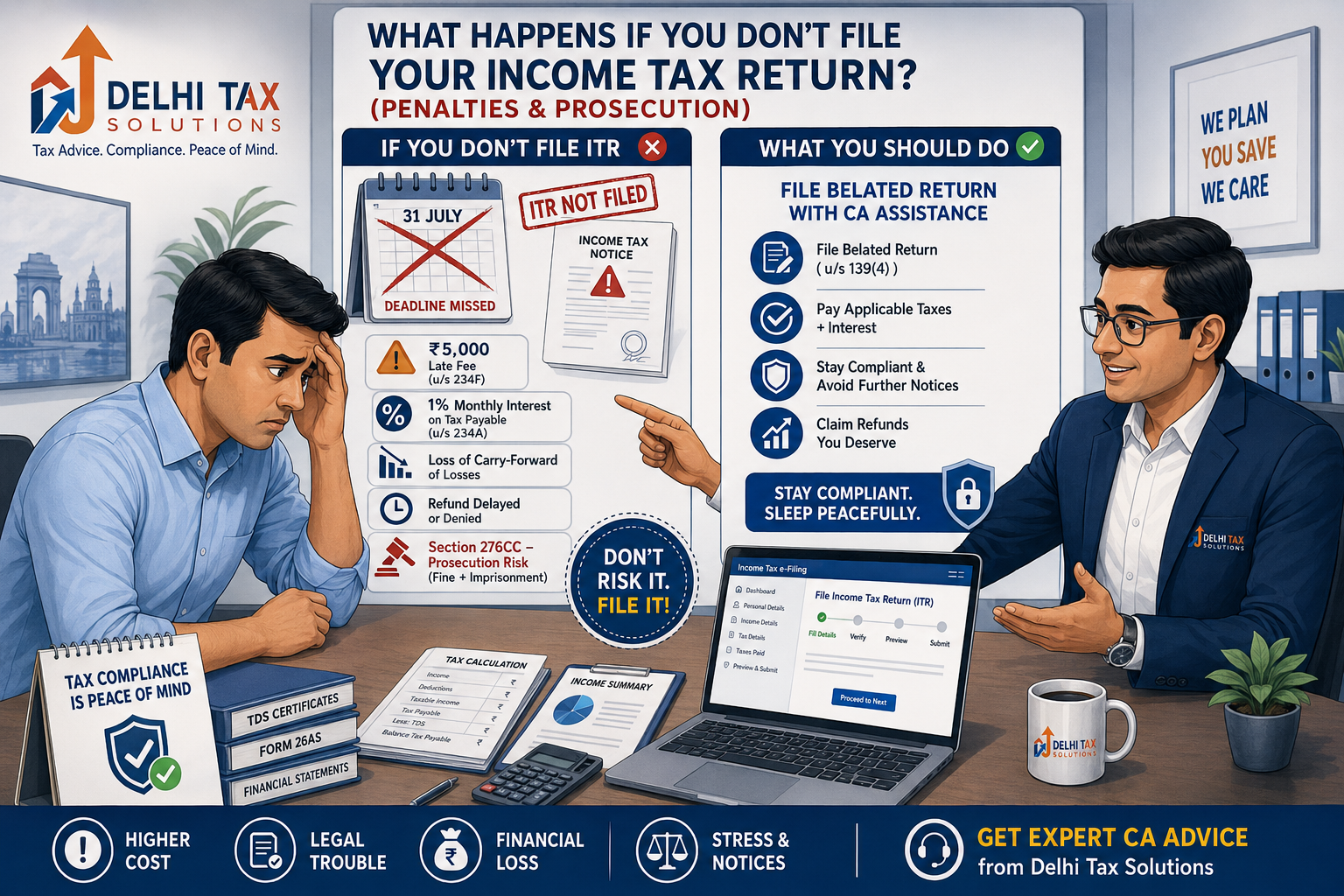
💡 Key Takeaways
- Failing to file your ITR triggers mandatory late fees up to ₹5,000 under Section 234F.
- Unpaid tax liabilities accumulate compounding interest at 1% per month under Sections 234A, 234B, and 234C.
- Skipping the deadline strips you of the right to carry forward business losses or capital losses to future years.
- You permanently forfeit or severely delay any eligible tax refunds tied to your TDS Compliance records.
- In extreme cases of tax evasion or willful default, taxpayers face criminal prosecution and imprisonment under Section 276CC.
Missing the annual income tax filing deadline is far more than a minor administrative oversight; it is an infraction that immediately activates a rigid, automated penalty machinery within the national tax grid. Every assessment year, thousands of taxpayers panic when they realize they have let the due date lapse, wondering whether ignoring the requirement altogether is a viable option. The short answer is an emphatic no. The Indian tax administration utilizes advanced data-matching algorithms to track non-filers, turning a blind eye into a costly mistake. Understanding exactly what happens if you don’t file ITR allows you to weigh the consequences and take immediate corrective action. Let us examine the legal, financial, and penal repercussions, ensuring your next Income Tax Filing gets back on track before authorities intervene.
Immediate Financial Penalties and Late Fees
Section 234F Late Filing Fees
The first direct consequence of missing the statutory due date (typically July 31st for non-audit cases) is the imposition of a mandatory fee under Section 234F. The penalty for not filing ITR after the due date but on or before December 31st of the assessment year is ₹5,000. However, if your total taxable income is ₹5 Lakhs or less, the maximum late fee is restricted to ₹1,000. If you fail to file even by December 31st, you are forced into the realm of belated returns, carrying these financial penalties indefinitely until submission.
Compounding Interest Under Sections 234A, 234B, and 234C
Beyond flat late fees, failing to file your return while holding an unpaid tax liability triggers severe interest charges. Section 234A levies a mandatory 1% per month (or part of a month) interest charge on the unpaid tax amount for the duration of the delay in filing. When combined with interest penalties for defaulting on advance tax installments (Sections 234B and 234C), your total financial debt to the government snowballs rapidly with each passing month.
The Loss of Carry-Forward Benefits
Forfeiting Business and Capital Losses
One of the most destructive consequences of missing ITR deadline is the outright forfeiture of your right to carry forward losses. If your business suffered a net loss during the financial year, or if you incurred capital losses from selling shares or real estate, Indian tax law allows you to offset these losses against future income to lower future tax bills. However, the Income Tax Act strictly stipulates that you can only carry forward these losses if you file your ITR on or before the original due date. Skipping the deadline means you absorb 100% of the loss yourself with zero tax relief in future years.
Impact on Wealth and Corporate Structures
For entrepreneurs and business owners, failing to file personal and business returns on time disrupts corporate compliance. If you operate an enterprise structured via formal Company Registration, missing compliance timelines can trigger disqualifications for directors and paralyze funding rounds. Similarly, individuals with heavy real estate portfolios cannot afford to ignore Property Tax reconciliations alongside their income tax filings, as cross-verification by the Income Tax Department will instantly flag discrepancies.
| Nature of Default / Delay | Statutory Penalty / Consequence |
|---|---|
| Filing after due date (by Dec 31st) | Late fee up to ₹5,000 under Section 234F (₹1,000 if income is under ₹5L). |
| Unpaid Tax Liability Delay | Compounding interest at 1% per month under Section 234A. |
| Missing Deadline with Net Losses | Complete forfeiture of right to carry forward business or capital losses. |
| Failing to file despite TDS deductions | Loss or indefinite freezing of tax refund payouts. |
| Willful evasion and notice default | Criminal prosecution and imprisonment under Section 276CC. |
⚡ In a Nutshell
Failing to file your income tax return leads to heavy late fees, steep compounding interest on unpaid dues, loss of loss carry-forward benefits, and potential criminal prosecution for willful default.
Severe Legal Prosecution and Imprisonment Risks
The Reality of Section 276CC Prosecution
While many believe non-filing only results in monetary fines, the law reserves severe teeth for chronic non-compliers. The prosecution for non filing ITR is governed by Section 276CC. If a taxpayer willfully attempts to evade tax or fails to furnish a return in response to statutory notices (such as under Section 142(1) or 148) where the tax evasion amount exceeds statutory limits, the tax department can initiate criminal proceedings. Conviction under these provisions carries rigorous imprisonment ranging from three months up to seven years, alongside heavy financial fines.
Notices, Scrutiny, and Assessment Orders
If you simply vanish and refuse to file, the tax administration will not simply forget about you. The Press Information Bureau frequently highlights automated data-matching initiatives that catch high-value non-filers. The department will issue formal notices demanding compliance. If you ignore them, the tax officer will pass a ‘Best Judgment Assessment’ under Section 144, calculating your tax liability based on external financial data (credit card spends, high-value bank deposits, GST Registration trails) and slapping maximum tax rates with punitive penalties.
How to Correct the Situation and Recover
Filing a Belated or Revised Return
If you have missed the primary deadline, do not compound the error by doing nothing. You can still file a ‘Belated Return’ under Section 139(4) anytime on or before December 31st of the assessment year (or before completion of assessment, whichever is earlier). While you will have to pay the Section 234F late fee and accumulated interest, filing a belated return shields you from severe prosecution and allows you to regularize your tax status.
Seeking Professional Expert Intervention
Navigating complex non-filing notices, settling advance tax interest, and clearing backlogs requires experienced professional guidance. Financial institutions and regulatory bodies like the Reserve Bank of India and the Ministry of Corporate Affairs maintain strict compliance records that link directly to your PAN. Do not risk your financial freedom or corporate standing by ignoring tax deadlines. Talk to a Delhi Tax Solutions expert today. Our certified Chartered Accountants will review your tax history, calculate your exact liabilities, draft formal responses to department notices, and bring your filings into 100% compliance.
The cost of non-compliance is always exponentially higher than the cost of filing on time. Understanding what happens if you don’t file ITR should serve as an urgent call to action to audit your financial records immediately. Whether you are dealing with unpaid late fees, trapped refunds, or looming departmental notices, proactive resolution is your best defense. Connect with Delhi Tax Solutions to secure expert CA assistance and put your tax worries behind you permanently.
About this article: Researched using official government sources and Delhi Tax Solutions’ in-house tax advisory team. Last updated August 2026.
Frequently Asked Questions (FAQs)
Q: What happens if you don’t file your income tax return in India?
A: If you do not file your ITR, you face immediate financial consequences including mandatory late fees up to ₹5,000 under Section 234F, compounding interest at 1% per month on unpaid taxes, loss of the right to carry forward business or capital losses, freezing of tax refunds, and in severe cases of willful evasion, criminal prosecution and imprisonment.
Q: What is the late fee under Section 234F for missing the ITR deadline?
A: The late fee under Section 234F is ₹5,000 if you file your return after the due date but on or before December 31st of the assessment year. However, if your total taxable income does not exceed ₹5 Lakhs, the late fee is capped at a lower amount of ₹1,000.
Q: Can I be prosecuted or sent to jail for not filing ITR?
A: Yes, under Section 276CC, chronic non-filers and willful tax evaders who ignore statutory notices can face criminal prosecution. Conviction can result in rigorous imprisonment ranging from three months up to seven years, alongside substantial financial penalties.
Q: What happens to my tax refunds and loss carry-forward benefits if I skip filing?
A: If you skip filing your ITR by the original due date, you completely forfeit the right to carry forward business or capital losses to offset future taxes. Furthermore, any eligible tax refunds tied to your TDS records will remain frozen or delayed indefinitely until a valid return or belated return is successfully processed.
Q: Is it still possible to file a belated ITR after the standard due date?
A: Yes, you can file a ‘Belated Return’ under Section 139(4) anytime on or before December 31st of the assessment year (or before the completion of assessment, whichever is earlier). While you must pay Section 234F late fees and applicable interest, filing a belated return helps you avoid harsher legal penalties and departmental scrutiny.
