? Key Takeaways
- Reverse mortgage payouts are completely tax-exempt as loans under Section 10(43).
- Senior citizens above 60 can unlock property value without selling their home.
- Transfer of residential property under approved schemes escapes capital gains tax.
- Legal heirs can settle the loan principal later to recover the family property.
Retirement planning in urban India often hits a major roadblock when accumulated savings fall short of soaring living expenses. Many senior citizens find themselves “asset rich but cash poor,” holding valuable residential real estate in Delhi NCR while struggling with monthly utility bills and healthcare costs. To bridge this financial gap, the reverse mortgage framework provides a reliable lifeline. Yet, a persistent cloud of confusion surrounds the fiscal implications of these cash flows, leading many elders to ask: are reverse mortgage payouts taxable under current Indian tax laws?
Based on rigorous cases handled by our CA team, misinformation often deters elderly homeowners from utilizing legal financial instruments designed for their security. Understanding the statutory boundaries eliminates unnecessary anxiety. This guide breaks down the legal architecture, statutory exemptions, and structural mechanics of reverse mortgage schemes in India. Property owners across Delhi NCR frequently pair retirement financial planning with professional Income Tax advisory, comprehensive Property Tax reviews, corporate Company Registration, and statutory TDS compliance audits.
Direct Answer: Taxability of Reverse Mortgage Payouts
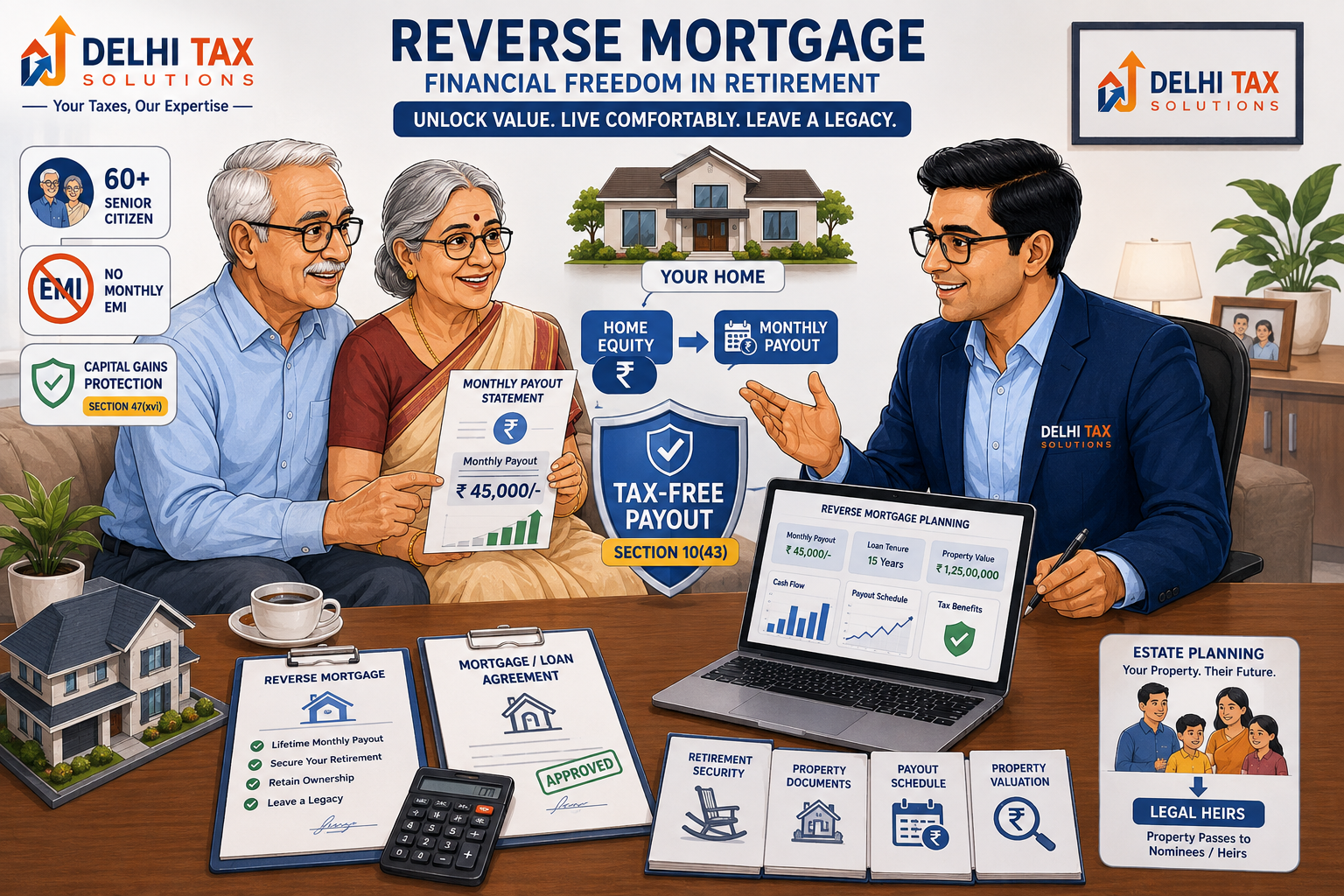
Are reverse mortgage payouts taxable? No, payouts received from a reverse mortgage loan—whether disbursed in monthly installments or as a lump sum—are completely tax-free in the hands of senior citizens. Under Section 10(43) of the Income Tax Act, 1961, any amount received by an individual as a loan under a notified reverse mortgage scheme is treated as a capital receipt rather than taxable income. Because it is legally classified as debt borrowed against an asset rather than earned revenue, the Income Tax Department levies zero income tax on these disbursements.
How Reverse Mortgage Scheme Tax Exemption Works
The operational mechanics of a reverse mortgage protect elderly homeowners from unexpected tax liabilities. Understanding how regulatory frameworks operate ensures complete peace of mind during your retirement years.
Statutory Protection Under Section 10(43)
The legislative intent behind Section 10(43) is to provide financial security to senior citizens aged 60 and above. When a bank or housing finance company approved by the National Housing Bank (NHB) disburses funds, those cash inflows are shielded from taxation. Borrowers do not need to declare these periodic receipts as income sources when filing their annual income tax returns.
Exemption from Capital Gains Tax
A major concern among property owners is whether mortgaging a home triggers capital gains liabilities. Section 47(xvi) of the Income Tax Act explicitly states that any transfer of a capital asset in a reverse mortgage transaction made under a scheme approved by the Central Government is not regarded as a transfer for capital gains computation. This means transferring property rights to a lending institution does not attract short-term or long-term capital gains tax.
Utilization of Loan Proceeds
Senior citizens enjoy complete autonomy regarding how they utilize the disbursed funds. Whether the money is deployed for medical emergencies, home renovation, or daily sustenance, the tax-free status of the loan remains intact.
? Quick Summary
Money borrowed against your own house is fundamentally a liability, not income. Because you are essentially receiving your home equity back in structured installments, the government treats it as a loan repayment vehicle exempt under Section 10(43).
Reverse Mortgage vs Regular Loan Tax Implications
Evaluating financial instruments requires comparing how liabilities affect personal balance sheets. While standard loans create repayment obligations out of current earnings, reverse mortgages function in reverse.
Cash Flow Dynamics for Retirees
Unlike standard loans where borrowers service EMIs from active salaries, reverse mortgage borrowers receive cash flows without immediate outlays. As per Reserve Bank of India guidelines, banks accumulate interest over time, which is settled only when the last surviving borrower permanently moves out or passes away.
Impact on Wealth and Estate Planning
For residential property, reverse mortgages impact inheritance because legal heirs must clear the accumulated loan balance to reclaim ownership of the house. However, any surplus amount realized from the final sale of the property after loan settlement is handed directly to the legal heirs tax-free.
| Feature | Reverse Mortgage Loan | Regular Home Loan |
|---|---|---|
| Target Borrower | Senior citizens (60 years and above) | Salaried or self-employed working individuals |
| Repayment Duty | No monthly repayment during lifetime; settled via property sale later | Regular monthly EMI payments starting immediately |
| Tax on Payouts | Exempt under Section 10(43) | Not applicable (loan disbursement is principal) |
| Tax Deductions | Available only if proceeds are used for home repairs | Deductions available on principal (Sec 80C) and interest (Sec 24) |
Capital Gains Protection and Property Transfer Rules
Navigating property ownership transfers demands strict adherence to statutory guidelines. Senior citizens often worry about losing legal title during the mortgage term.
Retaining Ownership Title
A common myth is that signing up for a reverse mortgage transfers home ownership to the bank. In reality, the senior citizen remains the registered owner and continues to occupy the residential property throughout their lifetime. The bank only holds a security mortgage charge over the real estate asset.
Settlement Options for Legal Heirs
According to Press Information Bureau policy announcements regarding senior welfare schemes, participating banks offer legal heirs clear pathways to redeem the property. Heirs can pay off the cumulative loan principal and accrued interest using their own funds or by selling the property.
Practical Tips for Senior Citizens Opting for Reverse Mortgage
Optimizing a reverse mortgage requires careful planning and consultation with certified tax professionals. Making informed decisions protects family interests over long tenures.
Evaluating Payout Tenures
Banks typically offer loan tenures ranging up to 20 years, depending on the borrower’s age and property valuation. Selecting between lump-sum disbursements and monthly annuity streams depends entirely on immediate liquidity needs versus long-term sustenance.
Integrating with TDS and Tax Filings
While reverse mortgage receipts are tax-free, retirees must still manage other income streams such as pensions, fixed deposit interest, or rental yields correctly. Integrating these streams with proper TDS return filing guidelines prevents unintended scrutiny from tax authorities.
Talk to a Delhi Tax Solutions expert today to evaluate your financial profile and explore specialized tax planning solutions tailored for your peace of mind.
About this article: Researched using official government sources and Delhi Tax Solutions’ in-house tax advisory team. Last updated August 2026.
This article is for general informational purposes and is not a substitute for personalised professional tax advice.
Frequently Asked Questions (FAQs)
Q: Are reverse mortgage payouts taxable under the Income Tax Act?
A: No, reverse mortgage payouts are not taxable. Under Section 10(43) of the Income Tax Act, 1961, any amount received by an individual as a loan—whether taken as a lump sum or in periodic monthly installments—is treated as a capital receipt and remains completely exempt from income tax. Senior citizens do not need to report these disbursements as taxable income when filing their annual tax returns.
Q: What is Section 10(43) of the Income Tax Act for reverse mortgage?
A: Section 10(43) is a specific statutory provision under the Income Tax Act, 1961, designed to protect senior citizens participating in an approved reverse mortgage scheme. It establishes that loan amounts disbursed against residential property mortgages are exempt from taxation, ensuring elders receive unhindered financial support during retirement without incurring tax liabilities.
Q: Do legal heirs have to pay capital gains tax when inheriting a reverse-mortgaged property?
A: No, legal heirs are not liable to pay capital gains tax upon inheriting or settling a reverse-mortgaged property. Under Section 47(xvi), the initial transfer of the property to the lending institution under a notified reverse mortgage scheme is exempt from capital gains. When heirs settle the loan principal and interest to release the property, or if the bank sells the property to recover dues, any surplus proceeds remaining after settling the loan are given to the heirs tax-free.
Q: How does a reverse mortgage differ from a regular home loan regarding tax?
A: A regular home loan is taken to buy or construct a property, requiring immediate monthly EMI payments where borrowers may claim tax deductions on principal and interest components. Conversely, a reverse mortgage is designed for senior citizens who already own a home, allowing them to receive periodic payouts from the bank. Payouts under a reverse mortgage are tax-free loan receipts under Section 10(43), and borrowers do not make monthly repayments during their lifetime.
Q: What is the maximum tenure for a reverse mortgage loan in India?
A: In India, the typical maximum tenure for a reverse mortgage loan ranges between 15 to 20 years, depending on the guidelines of the lending institution and the chosen mode of disbursement. When loan payments are channeled through an annuity provider like the Life Insurance Corporation of India (LIC) for lifetime periodic payments, disbursements can continue for the residual lifetime of the borrower while ensuring they retain permanent occupancy rights.
