
? Key Takeaways
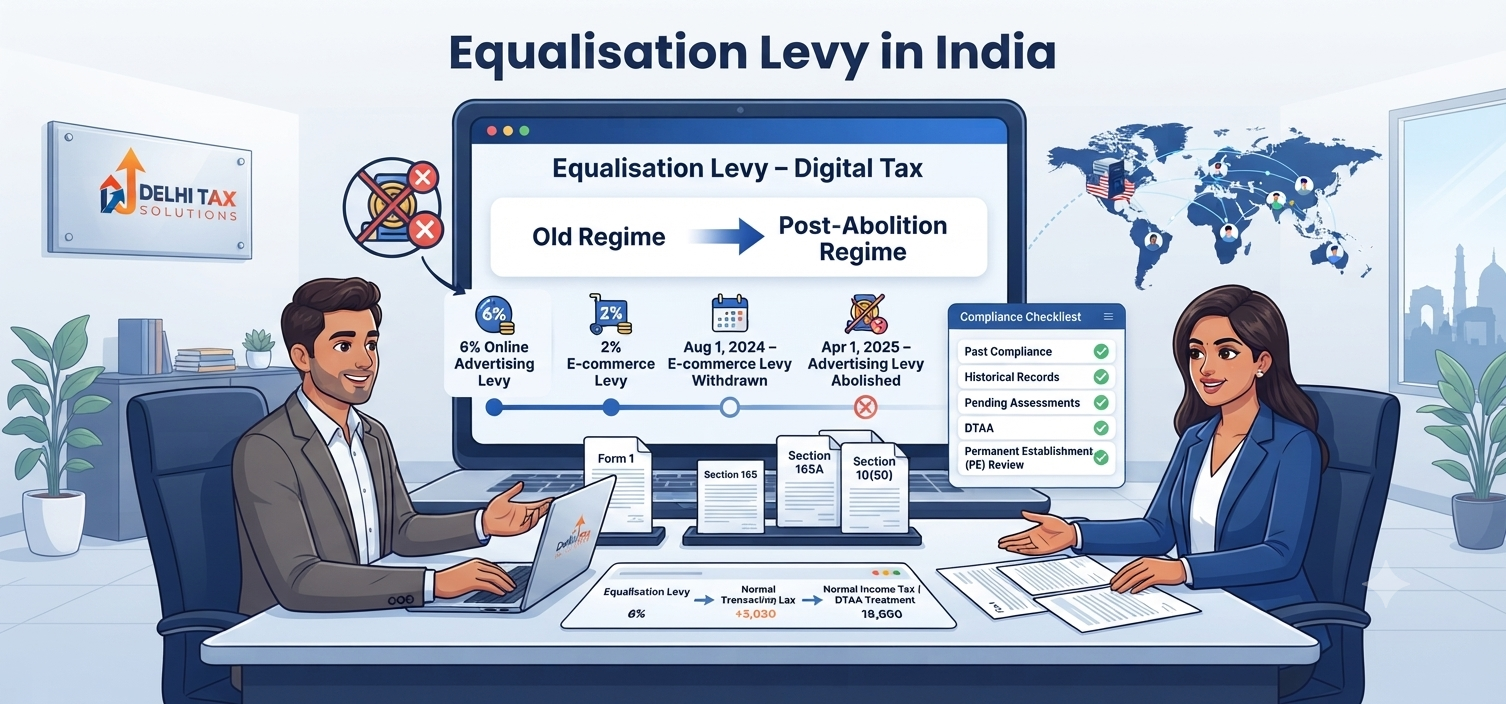
- India’s Equalisation Levy on e-commerce supplies was withdrawn effective August 1, 2024.
- The residual 6% levy on online advertising was completely abolished effective April 1, 2025.
- Section 10(50) income tax exemptions have sunset, returning foreign digital receipts to normal taxation.
- Past financial year compliance, Form 1 filings, and pending audits remain strictly enforceable.
- Multinational businesses must evaluate permanent establishment risks under current direct tax rules.
Managing cross-border digital transactions requires staying updated on shifting regulatory frameworks. Understanding equalisation levy digital services tax India mandates is vital for multinational operators and foreign tech giants navigating Indian revenue channels. For nearly a decade, India levied specialized charges on digital advertising and e-commerce supplies provided by non-residents lacking physical business footprints. However, recent legislative enactments have completely unwound this digital taxation regime.
Navigating these regulatory shifts requires aligning internal corporate finance protocols with direct tax statutes. Official policies administered by the Income Tax Department dictate how foreign receipts are classified post-abolition. Enterprises operating in commercial hubs across Delhi NCR must manage these compliance updates alongside routine Income Tax filings, Company Registration procedures, and TDS obligations.
This authoritative advisory guide breaks down the historical evolution, phase-out timelines, and ongoing compliance requirements associated with India’s digital tax framework.
What is the equalisation levy and how did it function?
The Equalisation Levy was a direct tax introduced under Chapter VIII of the Finance Act, 2016 to tax digital transactions involving non-resident companies that earned substantial revenue from Indian users without maintaining a physical Permanent Establishment (PE). Structured across two distinct phases, the framework imposed a 6 percent levy on online advertising services (EL 1.0) starting June 1, 2016, and a 2 percent levy on e-commerce supplies (EL 2.0) starting April 1, 2020. Official notifications published by the Press Information Bureau noted that these measures were designed to capture value created by foreign digital platforms within the domestic market.
What were the rules governing equalisation levy e-commerce?
Enforced under Section 165A of the Finance Act, 2016, rules regarding equalisation levy e-commerce targeted non-resident operators facilitating online sales of goods or services to Indian residents or users utilizing Indian IP addresses. The charge applied at a rate of 2 percent on gross consideration when aggregate turnover exceeded ?2 crore during the financial year. Guidance issued by the Reserve Bank of India and tax authorities required operators to self-assess and deposit these dues quarterly.
Gross turnover thresholds
The 2 percent e-commerce levy applied exclusively when aggregate consideration received or receivable by the non-resident operator reached or exceeded ?2 crore in a financial year.
Quarterly payment schedules
Unlike advertising levies deducted by Indian buyers, e-commerce operators were directly responsible for calculating and depositing quarterly dues through Challan ITNS 285.
What determined equalisation levy applicability for digital ads?
Determining equalisation levy applicability for digital advertising required examining whether a resident business or non-resident with an Indian PE made payments exceeding ?1 lakh annually to a foreign digital platform. Under Section 165, the Indian payer was legally mandated to deduct a 6 percent withholding tax at the time of credit or payment and deposit it by the seventh day of the following month. Regulatory circulars monitored by the Ministry of Corporate Affairs ensured strict reporting through annual Form 1 statements.
Withholding obligations
Indian business entities purchasing online advertising space from foreign publishers withheld 6 percent at source before remitting service fees.
Annual Form 1 filing
Deductors and operators were required to furnish an annual statement of equalisation levy in Form 1 to reconcile digital transactions with tax authorities.
| Levy Phase | Statutory Section | Tax Rate | Effective Operational Period |
|---|---|---|---|
| EL 1.0 (Online Advertising) | Section 165, Finance Act 2016 | 6% | June 1, 2016 – March 31, 2025 |
| EL 2.0 (E-commerce Supply) | Section 165A, Finance Act 2016 | 2% | April 1, 2020 – July 31, 2024 |
| Post-Abolition Regime | Normal Income Tax / DTAA | Varies | Effective August 1, 2024 / April 1, 2025 onwards |
| Exemption Provision | Section 10(50), Income Tax Act | Exempt | Sunset from Assessment Year 2026-27 |
? Quick Summary
India’s Equalisation Levy regime is fully defunct, with the e-commerce levy withdrawn in August 2024 and the advertising levy abolished in April 2025.
How does digital tax foreign companies India transition work?
Evaluating digital tax foreign companies India policies requires understanding the complete unwinding of the levy. The Finance Act 2024 abolished the 2 percent e-commerce levy effective August 1, 2024, while the Finance Act 2025 removed the residual 6 percent advertising levy effective April 1, 2025. Concurrently, Section 10(50) of the Income-tax Act—which exempted EL-taxed income from domestic income tax—features a sunset clause taking effect from Assessment Year 2026-27.
Revival of standard taxation
Foreign digital receipts that enjoyed statutory exemption under Section 10(50) now fall back under regular income tax scrutiny and Double Tax Avoidance Agreements (DTAAs).
Permanent establishment review
Tax advisors at Delhi Tax Solutions emphasize that foreign operators must re-evaluate their digital presence to prevent aggressive Permanent Establishment (PE) or Royalty/FTS assertions.
How to manage past compliance and pending tax audits?
Resolving historical liabilities requires recognizing that the repeal of the levy does not extinguish past compliance obligations. According to cases handled by our CA team at Delhi Tax Solutions, pending assessments, departmental scrutiny, and refund claims for financial years up to March 31, 2025, remain fully active under Chapter VIII. Businesses must maintain robust documentation matching historical deductions with GST Registration filings to withstand departmental reviews.
Audit retention mandates
Enterprises must preserve historical Challans, Form 1 filings, and vendor reconciliation sheets for prior tax periods to satisfy ongoing departmental audits.
Strategic professional guidance
Partnering with experienced tax professionals ensures seamless management of transitional tax structures and legacy dispute resolutions.
Talk to a Delhi Tax Solutions expert to get your corporate tax audits and compliance filings managed seamlessly today.
About this article: Researched using official government sources and Delhi Tax Solutions’ in-house tax advisory team. Last updated August 2026.
This article is for general informational purposes and is not a substitute for personalised professional tax advice.
Frequently Asked Questions (FAQs)
Q: What was the equalisation levy and why was it introduced in India?
A: The Equalisation Levy was introduced under Chapter VIII of the Finance Act, 2016 as a direct tax on digital transactions. Its primary objective was to ensure that foreign technology companies and e-commerce operators generating substantial revenues from Indian users without maintaining a physical permanent establishment contributed appropriate taxes on domestic economic activity.
Q: Is the equalisation levy still applicable for foreign companies in India?
A: No, the Equalisation Levy framework is entirely defunct. The 2 percent e-commerce levy was withdrawn effective August 1, 2024, and the residual 6 percent online advertising levy was completely abolished effective April 1, 2025. Foreign companies no longer deduct or pay equalisation levy on current digital transactions.
Q: What were the exact tax rates and thresholds for e-commerce and digital ads?
A: The framework operated with two distinct rates: a 6 percent withholding tax on online advertising services for annual considerations exceeding ?1 lakh, and a 2 percent direct levy on e-commerce supplies by non-resident operators whose aggregate gross receipts from Indian users exceeded ?2 crore during the financial year.
Q: How does the sunset of Section 10(50) impact foreign tech companies now?
A: With the insertion of a sunset clause in Section 10(50) of the Income-tax Act, income earned by non-residents that was previously exempt due to equalisation levy payment now falls under regular income tax provisions. Foreign enterprises must evaluate taxability under Section 9 and applicable Double Tax Avoidance Agreements (DTAAs).
Q: What compliance obligations remain for past equalisation levy periods?
A: The abolition of the levy is prospective and does not extinguish liabilities for prior periods. Enterprises must continue to maintain historical records, support pending assessments, respond to departmental notices, and defend prior Form 1 filings for financial years up to March 31, 2025.
