
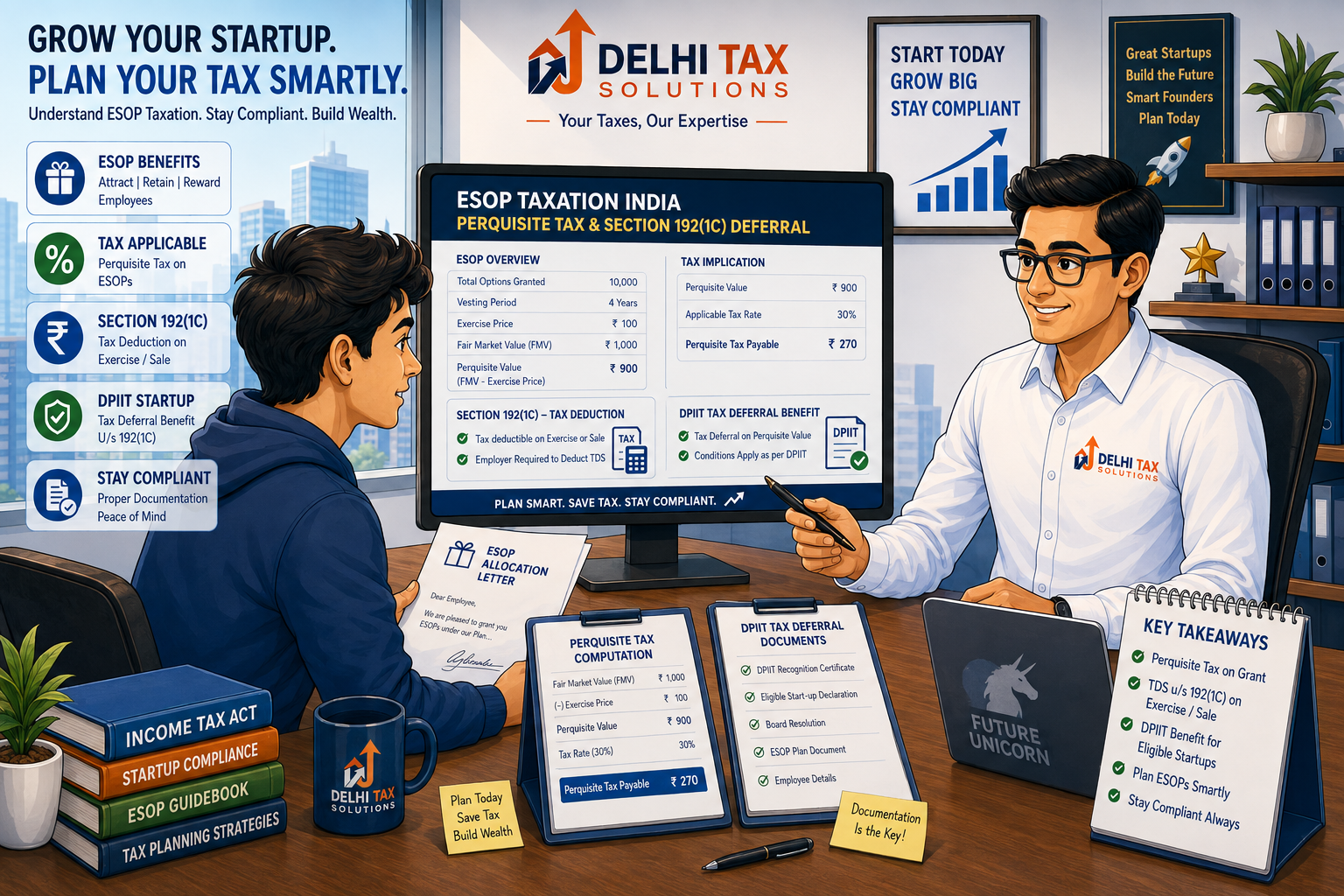
💡 Key Takeaways
- ESOP taxation in India follows a dual-stage trigger: perquisite tax at exercise and capital gains tax at sale.
- Perquisite value equals Fair Market Value (FMV) on exercise date minus the grant/exercise price paid.
- DPIIT-recognized eligible startups can defer perquisite TDS under Section 192(1C) for up to 48 months or exit.
- Unlisted startup shares attract short-term or long-term capital gains tax based on holding period after exercise.
- Expert tax planning prevents cash-flow crunch when paying tax on illiquid unlisted shares.
Employee Stock Ownership Plans (ESOPs) have emerged as the primary wealth-creation engine for Indian startup employees. From early-stage engineers to senior management, equity compensation aligns personal financial growth with company valuations. However, understanding the ESOP taxation India startup employees face requires navigating complex statutory mechanisms under the Income-tax Act, 1961. Unlike cash salary, ESOPs create tax liabilities before you ever receive actual bank credits. Employees often face massive tax bills on paper wealth while holding completely illiquid stock. Navigating these compliance steps without triggering tax notices demands professional oversight.
Failing to account for tax deadlines can create severe financial stress. Based on cases handled by our CA team at Delhi Tax Solutions, employees frequently mix up exercise-stage perquisites with sale-stage capital gains. Furthermore, startup founders often overlook the procedural requirements of corporate filings managed via the Ministry of Corporate Affairs. This authoritative guide breaks down statutory formulas, tax rates, and deferral provisions for startup equity holders.
What Is ESOP Taxation in India for Startup Employees?
The core framework for ESOP taxation India startup employees operate under is structured around two distinct events. First, when an employee exercises vested options, the discount provided by the company is taxed as a salary perquisite. Second, when the employee eventually sells those shares, the resulting profit is taxed as capital gains. Under guidelines published by the Income Tax Department, both stages carry separate compliance rules, tax rates, and filing obligations. Understanding this dual taxation is critical for managing personal cash flow effectively.
How Does ESOP Tax Work at Exercise vs Sale Stage?
Analyzing ESOP tax at exercise vs sale reveals how timing impacts your overall tax liabilities. At the exercise stage, you convert your options into actual company shares by paying the predetermined exercise price. The difference between the Fair Market Value (FMV) on the allotment date and the exercise price paid is treated as perquisite tax on ESOP under Section 17(2)(vi). Your employer deducts Tax Deducted at Source (TDS) on this amount according to your income tax slab rate. Proper TDS coordination is essential, and companies manage these disclosures through structured TDS Return Filing.
The second stage occurs when you sell your allotted shares during a buyback, secondary sale, or IPO. Capital gains are computed by subtracting the FMV on the exercise date (which served as your purchase cost) from the final sale price. If you hold unlisted startup shares for more than 24 months after exercise, gains qualify as Long-Term Capital Gains (LTCG). If sold within 24 months, profits are classified as Short-Term Capital Gains (STCG) and added directly to your taxable income. Evaluating LTCG STCG on unlisted ESOPs ensures you do not overpay taxes upon exit.
| Taxation Stage | Taxable Event | Tax Head & Computation Basis | Applicable Tax Rate |
|---|---|---|---|
| Exercise Stage | Allotment of shares upon paying exercise price | Perquisite Income = (FMV on Exercise Date – Exercise Price Paid) | Applicable Income Tax Slab Rate (up to 30% + surcharge) |
| Sale Stage (STCG) | Sale of unlisted shares within 24 months of exercise | Short-Term Capital Gain = (Sale Price – FMV at Exercise) | Added to total income, taxed at normal slab rate |
| Sale Stage (LTCG) | Sale of unlisted shares after 24 months of exercise | Long-Term Capital Gain = (Sale Price – FMV at Exercise) | Applicable LTCG rate for unlisted equity securities |
What Is the Deferred ESOP Tax Rule for Eligible Startups?
To relieve startup employees from paying upfront perquisite tax on illiquid shares, the Government introduced the deferred ESOP tax startups mechanism under Section 192(1C). This specific statutory relief applies exclusively to employees working for startups recognized under Section 80-IAC by the Department for Promotion of Industry and Internal Trade (DPIIT). Under this provision, employers are not required to deduct TDS on perquisites in the year of exercise. Founders looking to leverage these benefits must first complete formal business structuring and Startup India Registration to obtain eligible status.
Through Section 192 ESOP deferral, TDS payment on perquisite value is postponed to the earliest of three specific trigger events: expiry of 48 months (4 years) from the end of the relevant assessment year, the date the employee sells the shares, or the date the employee leaves the company. This deferral provides essential liquidity buffer for professionals building high-growth enterprises.
How Is Fair Market Value Determined for Unlisted Shares?
Determining the precise valuation of unlisted startup shares is mandatory for accurate perquisite computation. Income Tax Rules specify that the Fair Market Value of unlisted shares must be determined by a Category-I Merchant Banker registered with SEBI on the date of exercise. Employers cannot use arbitrary internal valuations or previous funding round estimates. The valuation certificate issued by the merchant banker forms the statutory basis for Form 16 perquisite reporting.
If an employee exercises options on a date where no fresh merchant banker valuation is available, the valuation conducted within 180 days prior to the exercise date remains valid. Maintaining certified valuation documents ensures complete transparency during routine tax filings. Emerging founders building entities should also coordinate corporate structuring alongside formal Company Registration to ensure equity documentation remains audit-proof.
What Happens to ESOP Taxes When You Resign from a Startup?
Resigning from a startup triggers important compliance checks regarding your exercised equity holdings. If you exercised ESOPs in a non-eligible startup, your perquisite tax was already deducted at exercise, meaning you own the shares outright subject to company articles. However, if you benefited from tax deferral under Section 192(1C), your departure serves as an immediate tax trigger event. Your former employer must deduct the deferred perquisite TDS within 14 days of your resignation date.
Employees must plan for this outflow before handing in their notice. In many cases, resigning from a startup without immediate share liquidity forces employees to pay significant cash taxes out-of-pocket. Consulting experienced CA advisors allows professionals to structure exercise timing and departure schedules smoothly.
⚡ In a Nutshell
ESOPs are taxed twice in India: first as salary perquisites based on FMV minus exercise price upon option exercise, and second as capital gains upon final share sale. DPIIT-recognized Section 80-IAC startups can defer exercise perquisite TDS for up to 48 months or until employee exit/sale.
Managing employee equity requires careful balancing of statutory timelines, valuation certificates, and annual tax returns. Because tax rules and threshold calculations update regularly across fiscal years, working alongside dedicated professionals protects your wealth. Our tax advisory team at Delhi Tax Solutions helps startup employees and founders audit equity plans, compute accurate perquisites, and file compliant returns efficiently.
Talk to a Delhi Tax Solutions expert today to get your ESOP capital gains and income tax returns filed with complete accuracy and total peace of mind.
About this article: Researched using official government sources and Delhi Tax Solutions’ in-house tax advisory team. Last updated August 2026.
This article is for general informational purposes and is not a substitute for personalised professional tax advice.
Frequently Asked Questions
Q: How are ESOPs taxed at the time of exercise vs sale in India? +
A: ESOPs can involve taxation at two distinct stages. At the exercise stage, the difference between the applicable Fair Market Value and the exercise price may be treated as a salary perquisite. When the shares are subsequently sold, the difference between the sale price and the applicable cost basis is generally considered for capital gains taxation.
Q: What is the deferred ESOP tax benefit for eligible startup employees? +
A: Eligible employees of qualifying startups may be able to defer the TDS associated with an ESOP perquisite under the applicable provisions. The deferred tax generally becomes payable upon the earliest applicable trigger event, such as the prescribed time limit, sale of the shares, or cessation of employment, subject to the conditions of the law.
Q: How is Fair Market Value calculated for unlisted startup ESOPs? +
A: For unlisted shares, the Fair Market Value used for ESOP perquisite taxation is determined according to the prescribed Income Tax Rules and applicable valuation requirements. The valuation generally needs to be supported by a report from an appropriately qualified merchant banker as prescribed under the tax rules.
Q: What happens to ESOP taxation if I quit the startup before selling the shares? +
A: If ESOP-related perquisite tax was deferred under an eligible startup provision, cessation of employment can become one of the relevant tax trigger events. The employer may then have to account for the deferred TDS according to the applicable rules, even if the employee has not yet sold the shares.
Q: What are the capital gains tax rules for unlisted startup ESOP shares? +
A: When unlisted shares acquired through ESOPs are sold, the resulting profit may be taxable as short-term or long-term capital gains depending on the applicable holding-period rules. The capital gain is generally determined using the prescribed cost of acquisition, which can include the FMV considered for perquisite taxation at exercise.
Q: Can ESOP tax be payable even if I have not received cash? +
A: Yes. One of the major challenges with ESOPs is that the exercise-stage perquisite can create a tax liability even though the employee has not yet sold the shares or received cash from the investment. This is why exercise timing and liquidity planning are important for employees holding unlisted startup equity.
Q: What documents should I keep for ESOP tax filing? +
A: Keep your ESOP grant letter, vesting details, exercise statement, exercise price records, FMV or merchant banker valuation, Form 16, TDS records, share certificates or demat statements, and sale contract notes. These documents help establish the perquisite value, cost of acquisition, holding period and capital gains.
