
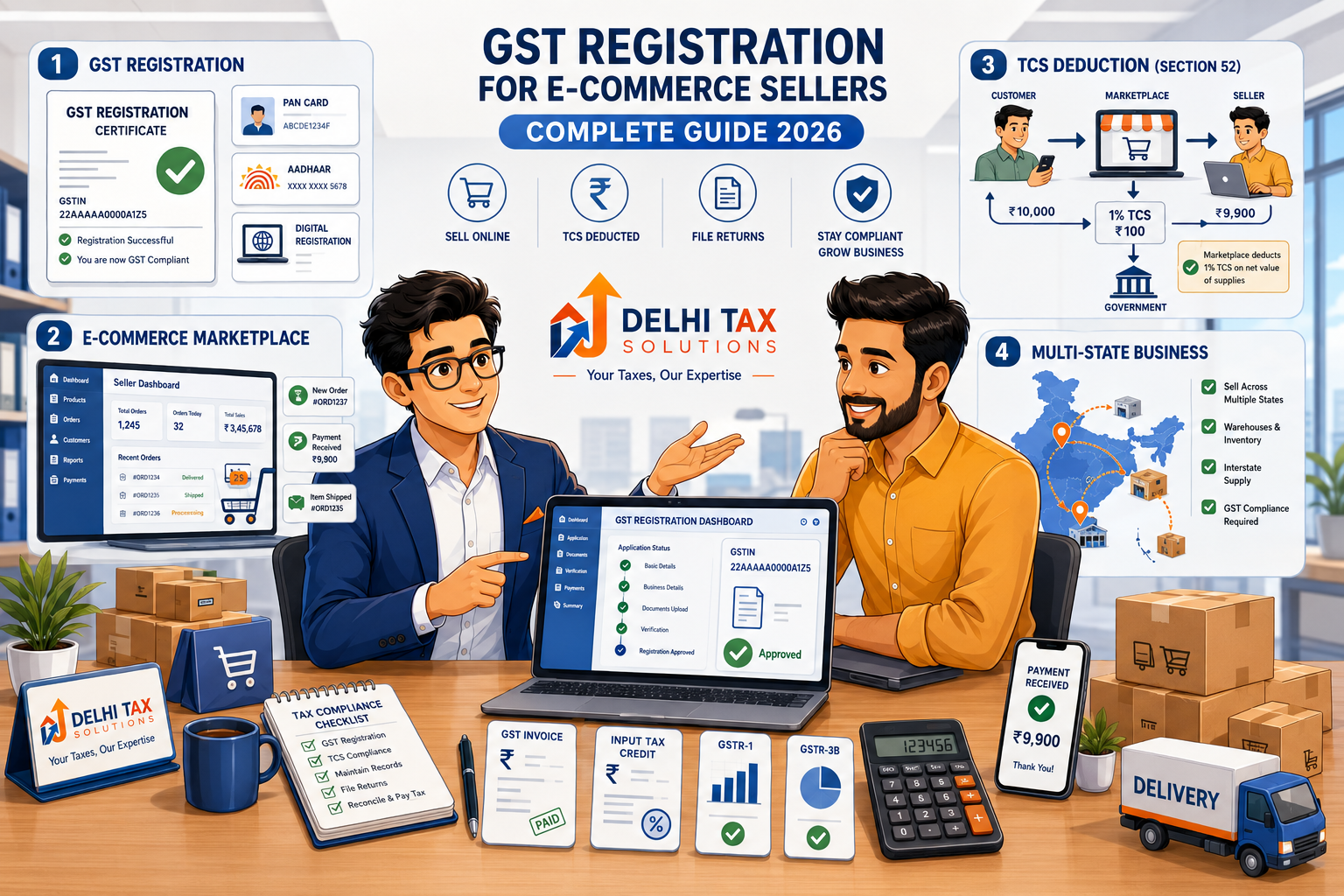
💡 Key Takeaways
- GST registration is strictly mandatory for all e-commerce sellers regardless of annual turnover limits.
- Online marketplaces deduct one percent Tax Collected at Source on net taxable supplies.
- Vendors must provide valid PAN, bank accounts, and principal place of business proofs.
- Multi-state warehousing requires separate registrations in each operating state jurisdiction.
- Expert CA oversight ensures seamless portal submission and error-free tax filing.
Expanding retail operations across digital storefronts in India offers incredible growth potential for emerging entrepreneurs. However, digital retail founders must navigate complex indirect tax regulations from day one of their operations. Securing proper GST Registration for E-commerce Sellers is not merely an administrative formality; it is a strict legal prerequisite under the modern indirect tax framework. Without a verified Goods and Services Tax Identification Number (GSTIN), major digital marketplaces will block your seller account and withhold payouts immediately.
Navigating online portal utilities and understanding distinct platform rules can feel overwhelming for growing startup founders. Whether you sell handcrafted lifestyle goods on your proprietary D2C website or list high-volume consumer electronics on multi-vendor marketplaces, compliance protects your business capital. The Goods and Services Tax network provides an automated framework designed to track digital transactions seamlessly across state boundaries.
What is GST Registration for E-commerce Sellers and Why Is It Mandatory?
GST Registration for E-commerce Sellers refers to the official digital onboarding procedure through which online marketplace vendors acquire a unique 15-digit tax identification number under Section 24 of the Central Goods and Services Tax Act. Unlike traditional brick-and-mortar retail shops that enjoy ₹20 lakh or ₹40 lakh turnover exemption thresholds, online sellers engaging in electronic commerce through an e-commerce operator must register immediately. This compulsory rule applies from your very first rupee of online revenue, ensuring complete transparency across digital supply chains.
Understanding Tax Collected at Source (TCS) and Platform Withholdings
Operating an online retail storefront involves unique financial withholding mechanisms managed directly by platform operators. Every digital marketplace must deduct one percent Tax Collected at Source (TCS) under Section 52 before releasing weekly settlement payouts to vendors. This deducted amount is deposited directly into the government treasury and reflects electronically in the seller’s electronic cash ledger. Grasping how TCS operates prevents cash flow disruptions and reconciles annual earnings accurately.
Marketplace platforms calculate this withholding based on the net value of taxable supplies fulfilled through their portals. To claim credit for these withholdings, vendors must file timely monthly returns matching platform statements. According to notifications issued by the Press Information Bureau, digital transaction transparency has significantly expanded tax collections across Indian states.
Reconciling these ledgers requires diligent bookkeeping and professional corporate support. For businesses scaling up operations, securing formal Company Registration establishes a solid corporate foundation.
Essential Documents and Prerequisites for Online Marketplace Onboarding
Compiling accurate paperwork is the single most critical step in securing fast portal approval without facing official query notices. Gathering the right documents required for amazon flipkart gst registration prevents administrative roadblocks during verification. Sole proprietors must provide a PAN card, Aadhaar card, bank account statement or cancelled cheque, and valid proof of business address such as an electricity bill or rent agreement.
For corporate entities like private limited companies and limited liability partnerships, additional governance paperwork is mandatory. As per guidelines outlined by the Ministry of Corporate Affairs, businesses must submit their Certificate of Incorporation, board resolutions, and promoter KYC documents.
Furthermore, if you utilize third-party fulfillment centers or warehouses across different states, you must acquire separate registrations for each operational location. Coordinating these requirements through professional GST Registration services ensures flawless portal execution.
Decoding Turnover Exemption Threshold Rules for Digital Retailers
A common misconception among early-stage entrepreneurs is that small-scale online traders can utilize standard turnover exemptions. Evaluating the exact gst turnover threshold exemption online sellers reveals that compulsory registration overrides general turnover limits. While offline service providers and physical traders enjoy high exemption limits, Section 24(ix) of the CGST Act strips away this relief for any business supplying goods or services through an electronic commerce aggregator.
Economic stability and monetary oversight are heavily emphasized by regulatory institutions like the Income Tax Department. Aligning your digital turnover reports with direct tax filings ensures absolute compliance across federal databases. For specialized retail categories, securing proper regulatory approvals through Business Licenses remains equally vital.
Compliance Comparison: Traditional Retail vs. E-Commerce Selling
Reviewing the regulatory contrast below highlights why online sellers cannot rely on traditional turnover exemptions.
| Compliance Parameter | Traditional Offline Retailer | E-Commerce Marketplace Seller |
|---|---|---|
| Exemption Threshold | Up to ₹40 Lakhs (Goods) / ₹20 Lakhs (Services) | Nil (Compulsory from Day One) |
| TCS Deduction Requirement | Not Applicable | Mandatory 1% Deduction by Operator |
| Multi-State Warehousing | Single registration usually sufficient | Separate GSTIN required in each stocking state |
⚡ In a Nutshell
E-commerce sellers do not enjoy turnover exemptions. Registration is legally required before listing products online, and marketplace operators will deduct one percent TCS on your taxable sales.
Managing Monthly and Annual Compliance Through Return Filing
Securing your tax certificate is only the beginning of your digital compliance obligations. Vendors must execute routine monthly gstr filing for digital storefronts to report monthly sales, claim eligible Input Tax Credit, and reconcile TCS statements. Standard monthly filing includes GSTR-1 for outward supplies and GSTR-3B for summary tax payments. Missing these statutory deadlines attracts heavy late fees and interest penalties.
Maintaining flawless purchase records allows businesses to offset tax liabilities legally. Expert advisory teams recommend conducting monthly reconciliations between marketplace settlement reports and portal data. Staying updated on legislative amendments via Direct Tax Code insights helps businesses plan their tax liabilities proactively.
Securing Your Digital Venture With Professional Chartered Accountant Guidance
Navigating complex portal documentation, HSN code classifications, and multi-state tax rules requires meticulous precision. Partnering with experienced Chartered Accountants eliminates administrative guesswork, ensures flawless digital application submission, and protects your business from avoidable rejection notices. Professional advisors verify every supporting document before submission to guarantee rapid certificate generation.
Professional oversight guarantees complete operational peace of mind. Let our experienced advisory team handle your regulatory filings so you can focus entirely on scaling your core e-commerce operations across digital marketplaces.
Conclusion
Mastering indirect tax compliance is essential for every digital entrepreneur and e-commerce seller operating in India today. Remember that online sellers have zero turnover exemption thresholds, marketplaces automatically deduct one percent TCS, and meticulous document preparation ensures rapid portal approval. Do not let complex digital paperwork compromise your commercial growth. Talk to a Delhi Tax Solutions expert to get your GST registration filed accurately and promptly by our professional CA team. Proactive compliance secures your business future.
About this article: Researched using official government sources and Delhi Tax Solutions’ in-house tax advisory team. Last updated August 2026. This article is for general informational purposes and is not a substitute for personalised professional tax advice.
Frequently Asked Questions (FAQs)
+ Q: Why is GST registration mandatory for e-commerce sellers even with low annual turnover?
A: Under Section 24 of the Central Goods and Services Tax Act, standard turnover exemption thresholds of twenty lakh or forty lakh rupees do not apply to businesses supplying goods or services through an electronic commerce aggregator. Every online merchant must acquire a verified registration number from day one of their operations to ensure transaction traceability, prevent platform account suspensions, and comply with mandatory indirect tax laws enforced across Indian state jurisdictions via the official GST Portal.
+ Q: How does Tax Collected at Source (TCS) affect payouts on platforms like Amazon and Flipkart?
A: Online marketplace operators are legally required to deduct one percent Tax Collected at Source on the net value of taxable supplies made through their platform under Section 52. This deducted amount is deposited directly into the government treasury on behalf of the vendor and reflects in their electronic cash ledger. Sellers can claim credit for these withholdings during their monthly return filings, provided platform settlement reports match their accounting books.
+ Q: What specific documents are required for online marketplace GST registration?
A: Standard document requirements for online e-commerce sellers include a valid PAN card, Aadhaar card, passport-sized photographs, and active bank account proof such as a cancelled cheque or bank statement. Additionally, vendors must submit valid address proof for their principal place of business, such as an electricity bill or registered rent agreement with a landlord NOC, along with corporate incorporation papers issued by the Ministry of Corporate Affairs if operating as a private limited company.
+ Q: Are e-commerce sellers eligible for the standard ₹40 lakh or ₹20 lakh GST turnover exemptions?
A: No, online e-commerce marketplace sellers are entirely ineligible for standard turnover exemption thresholds under current Indian tax law. Even if an online vendor generates nominal sales of only a few thousand rupees annually, compulsory registration provisions under Section 24 mandate that a GSTIN must be acquired before listing any products on digital retail aggregators or multi-vendor platforms.
+ Q: How should online sellers manage monthly and quarterly GST return filings and reconciliations?
A: Online merchants must file regular monthly returns, specifically GSTR-1 for reporting outward taxable supplies and GSTR-3B for summarizing total tax liabilities and claiming Input Tax Credit. Vendors must carefully reconcile their electronic commerce settlement statements with portal data to ensure matching figures, avoid late fees, and prevent mismatches that could trigger automated scrutiny notices from tax authorities.