
? Key Takeaways
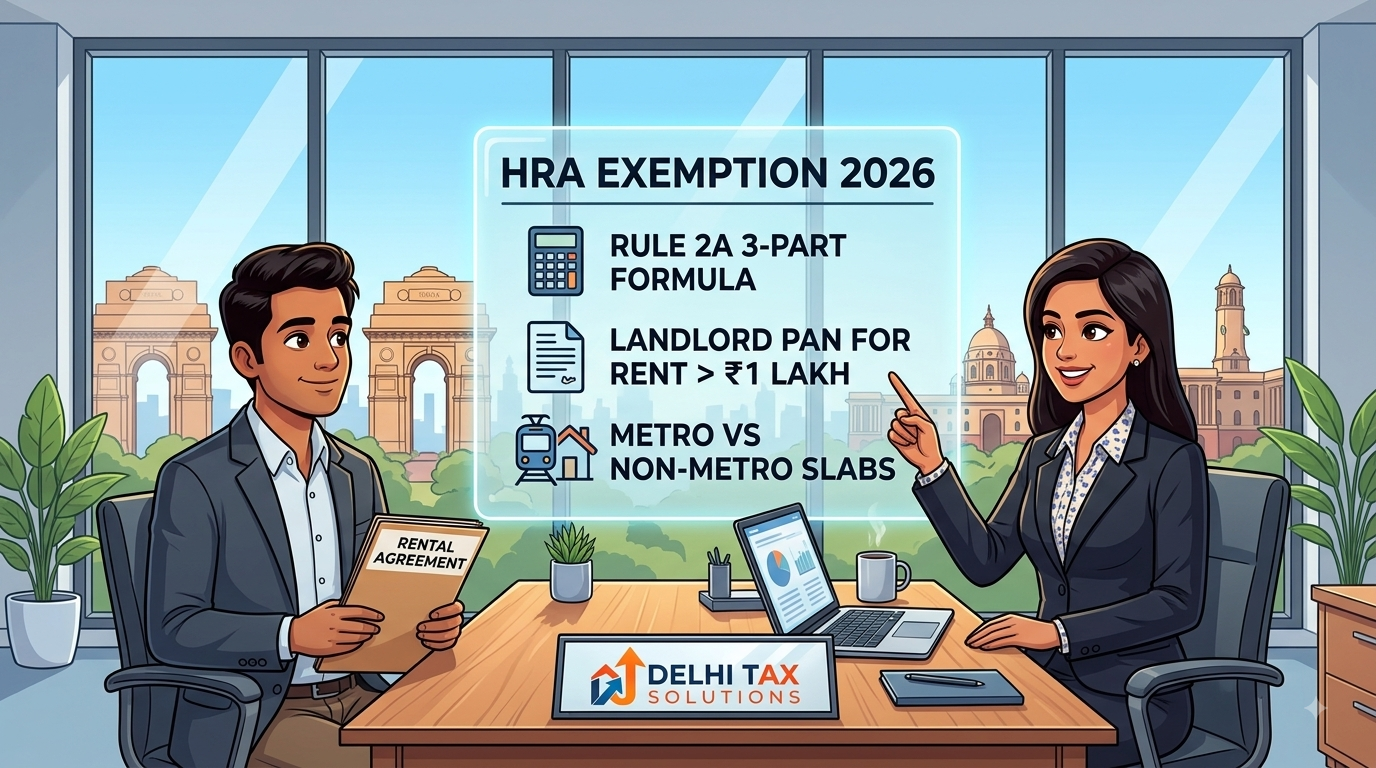
- House Rent Allowance (HRA) is partially or fully tax-exempt under Section 10(13A) of the Income Tax Act.
- Rule 2A dictates that the exemption equals the least of three specific mathematical components.
- Landlord PAN details are legally mandatory if annual rent payments exceed ?1 lakh.
- Choosing the new default tax regime means forfeiting HRA claims entirely in exchange for lower slabs.
- Salaried employees living in metro cities like Delhi can claim up to 50% of their basic salary.
Paying monthly rent in a bustling metropolitan area like Delhi/NCR takes a massive bite out of any salary. Fortunately, the Indian tax framework acknowledges this financial burden through the House Rent Allowance. Mastering your HRA exemption calculation is the single most effective way for a salaried employee to legally shrink their taxable income. Without this deduction, you end up paying tax on money that went straight to your landlord.
Many professionals glance at their Form 16, trust their employer’s automated math, and never verify if they claimed their full legal benefit. This complacency often leaves thousands of rupees on the table. With the ongoing coexistence of the old and new tax regimes in Tax Year 2026-27, understanding how HRA functions is more important than ever. This comprehensive guide breaks down the statutory rules under Rule 2A, explains the precise three-part formula, and shows you how to organize your paperwork perfectly.
What Is HRA Exemption Calculation?
An HRA exemption calculation is the statutory computation under Section 10(13A) and Rule 2A that determines how much of your employer-provided House Rent Allowance is exempt from income tax. Governed by specific income formulas, the exempt amount equals the least of three values: actual HRA received, rent paid minus 10% of basic salary plus dearness allowance, and 50% of basic salary for metro cities like Delhi or 40% for non-metros.
What Are the Core HRA Exemption Rules Under Rule 2A?
Understanding the legal framework prevents unpleasant surprises during annual return filings. Under the official **HRA exemption rules**, the tax department does not grant a flat exemption; everything depends on a strict three-part comparative test defined in Rule 2A of the Income-tax Rules.
The Three-Part Statutory Formula
To compute your tax-free allowance, you must calculate three distinct monetary figures and select the absolute lowest number. The first figure is the actual HRA amount your employer credits to your monthly paycheck. The second figure is the excess rent you paid over 10% of your basic salary plus dearness allowance. The third figure is 50% of your basic salary if you reside in Delhi, Mumbai, Kolkata, or Chennai, or 40% if you live in any other city.
Definition of Salary Components
For this calculation, “salary” strictly includes your basic salary, dearness allowance (if terms of employment provide for it), and commission calculated as a fixed percentage of turnover. Special allowances, bonuses, and taxable perks are entirely excluded from the basic pool. According to data published by the Press Information Bureau, aligning salary structures correctly prevents widespread payroll discrepancies during corporate audits [1].
| Component Parameter | Calculation Rule | Example (Basic ?50,000/mo) |
|---|---|---|
| 1. Actual HRA Received | Total allowance paid by employer annually. | ?2,40,000 per year |
| 2. Rent Paid minus 10% Basic | Annual rent paid minus 10% of basic salary. | ?3,00,000 rent ? ?60,000 = ?2,40,000 |
| 3. City-Based Percentage | 50% of basic (Metro) or 40% (Non-Metro). | ?3,00,000 (50% of ?6 Lakh basic in Delhi) |
Why Collecting Proper Rent Receipts for HRA Is Critical
Mathematical formulas mean nothing if you lack the paperwork to back them up. Securing a valid rent receipt for HRA submissions is your primary defense during an audit by the Income Tax Department [2].
Mandatory Details on Receipts
A valid rent receipt must contain your landlord’s full legal name, the complete rental property address, the exact monthly rent amount, and the revenue stamp affixed with the landlord’s signature. Furthermore, if your total annual rent payment exceeds ?1,00,000 (?8,333 per month), providing your landlord’s PAN card details to your employer is a strict statutory requirement.
Consequences of Missing Landlord PAN
If your rent exceeds ?1 lakh a year and your landlord refuses to share their PAN, your employer will reject your HRA claim, resulting in a sudden, massive tax deduction in your final months of Form 16 processing. If you live with your parents, you can legally pay rent to them and claim HRA, provided they own the property and declare that rental income in their own tax returns.
[LINK GAP — no live page found: suggested topic: HRA Calculator Delhi Guide]
How Does HRA vs Home Loan Tax Benefit Compare?
A frequent dilemma for growing professionals is evaluating **HRA vs home loan tax benefit** options. Choosing between renting and buying involves complex tax math.
Can You Claim Both Simultaneously?
Yes, you can legally claim both HRA and home loan tax benefits at the same time if you own a residential property in one city (and are paying an EMI on a home loan) while living in a rented house in another city due to your employment. Even within the same city, if your owned property is rented out to someone else and you live in a separate rented apartment, you can claim both deductions.
Deduction Limits
Under a home loan, you can claim up to ?2 lakh per year on housing loan interest under Section 24(b) and up to ?1.5 lakh on principal repayment under Section 80C. When compared to HRA—which is uncapped numerically and depends entirely on your salary structure—evaluating which path yields higher tax savings requires careful financial modeling.
? Quick Summary
You can claim both HRA and home loan tax benefits simultaneously if your owned property is in a different city or rented out. Remember that annual rent exceeding ?1 lakh strictly requires your landlord’s PAN card details.
Old vs New Tax Regime: Is HRA Dead?
The introduction of the concessional tax regime altered financial planning across India. Taxpayers must weigh allowances against lower slab rates.
The New Tax Regime Rules
Under the new default tax regime for Tax Year 2026-27, allowances like HRA, LTA, and Chapter VI-A deductions (Sections 80C, 80D) are entirely disallowed. In exchange, the government offers lower tax slab rates and a standard deduction.
Making the Right Choice
If you pay heavy rent in Delhi/NCR and have active home loans, the old tax regime often results in a lower overall tax liability. Consulting our expert team for professional Income Tax / ITR Filing advisory services ensures you choose the most financially advantageous regime every year.
Business and Employer Compliance for Payroll Deductions
For startup founders, MSME owners, and employers in Delhi/NCR, managing employee HRA claims is a core corporate responsibility.
Employer Verification Obligations
Employers must collect rent receipts and landlord PAN details before approving HRA exemptions in monthly payroll computations. Failing to verify these documents exposes the company to short-deduction notices during quarterly TDS Returns filings.
Corporate Structure Alignment
When establishing a commercial enterprise through proper Company Registration, founders must structure salary components correctly. Furthermore, business entities must reconcile payroll expenses with indirect tax reports on the GST Portal via their GST Registration to maintain total compliance [3].
Conclusion
Mastering the HRA exemption calculation is essential for maximizing your take-home salary under the old tax regime. By understanding the Rule 2A formula—comparing actual HRA, rent minus 10% basic, and metro allowances—you can verify your tax savings accurately. Collecting valid rent receipts and securing your landlord’s PAN for annual rents exceeding ?1 lakh protects your claims from employer rejection.
Do not let avoidable payroll documentation errors inflate your annual tax liability. Review your salary structure and organize your rent receipts early. Talk to a Delhi Tax Solutions expert to get your GST registration filed within 3 days or to have our CA team handle your complete personal and corporate tax filings seamlessly.
About this article: Researched using official government sources and Delhi Tax Solutions’ in-house tax advisory team. Last updated August 2026.
Disclaimer: This article is for general informational purposes and is not a substitute for personalised professional tax advice.
Frequently Asked Questions (FAQs)
+ Q: How is the HRA exemption calculated under Indian tax laws?
A: The House Rent Allowance exemption is calculated under Rule 2A as the least of three specific components: first, the actual HRA received from your employer; second, the excess of rent paid over 10% of your basic salary plus dearness allowance; and third, 50% of your basic salary if you reside in a metro city like Delhi, Mumbai, Kolkata, or Chennai, or 40% if you live in any other non-metro location.
+ Q: What are the mandatory documents required to claim HRA?
A: To successfully claim HRA exemptions, you must submit signed rent receipts containing your landlord’s name, property address, and revenue stamps. Additionally, if your total annual rent payment exceeds ?1,00,000, you are legally required to provide your landlord’s Permanent Account Number (PAN). Providing a formal rental agreement is also standard practice requested by corporate employers during tax proof submissions.
+ Q: Can I claim HRA if I live in my parents’ house?
A: Yes, you can legally claim HRA while living in a house owned by your parents, provided you genuinely pay them monthly rent through bank transfers or signed receipts, and they legally own the property. Your parents must declare that rental income under ‘Income from House Property’ in their own tax returns. However, you cannot claim HRA if you live in a property owned by your spouse.
+ Q: Can I claim both HRA and home loan tax benefits simultaneously?
A: Yes, you can claim both HRA and home loan tax benefits at the same time under specific circumstances. This is permissible if your owned property (for which you are paying an EMI) is located in a different city from your workplace, or if your owned property is rented out to a third party while you reside in a separate rented apartment due to employment requirements in the same city.
+ Q: Is a landlord’s PAN card mandatory for HRA claims?
A: A landlord’s PAN card is mandatory for HRA claims only if your total annual rent payment exceeds ?1,00,000 (?8,333 per month). If your annual rent is below this threshold, landlord PAN details are not legally required by your employer or the tax department. However, if your rent crosses ?1 lakh and you fail to provide the PAN, your HRA exemption will be completely denied.
